Hong Cun
The Geometry of Time.
A Traveler's Guide to China's Village in the Painting.
Discover the ancient water village of Anhui province, where Ming Dynasty architecture meets mountain streams and every turn reveals a picture-perfect moment.
There are places that feel untouched by time. And then there is Hongcun.
Tucked at the foot of the Huangshan Mountains in southern Anhui province, this UNESCO World Heritage site has existed for more than 900 years. It has survived dynasties, wars, and the relentless march of modernity. And yet, walk its narrow cobblestone alleys today, and you'll find a village that is not frozen in time, but living gracefully within it.
They call Hongcun the "Village in the Painting" a name that makes sense the moment you see the South Lake at dawn, when the old houses and their reflections become indistinguishable. But Hongcun is more than a photograph. It is a place to wander, to taste, to sit in a centuries-old courtyard with a coffee and watch the world slow down.
This guide is for the traveler who wants to do more than just see Hongcun. It's for those who want to feel it.
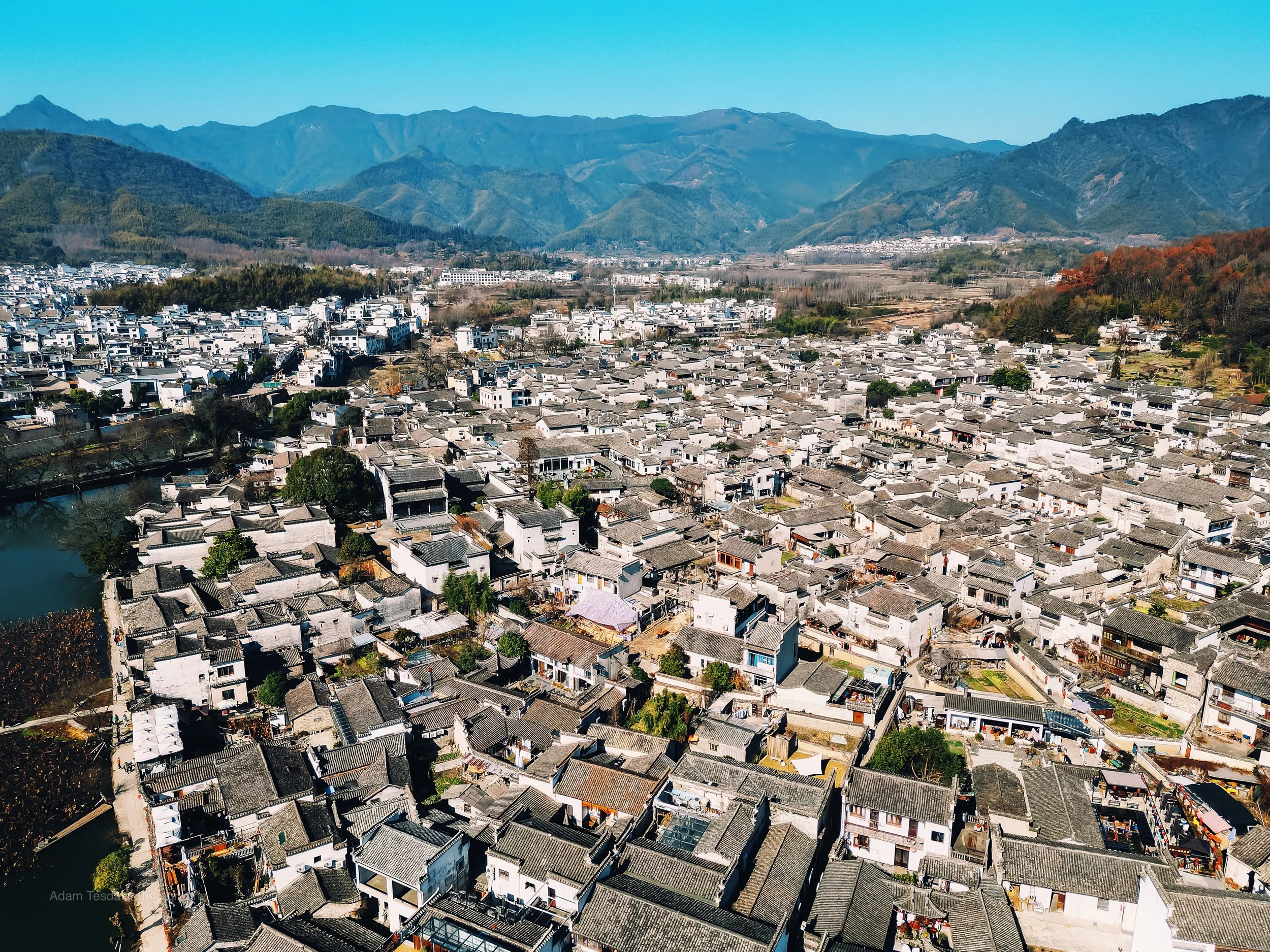
From the ground, Hongcun is a labyrinth a intimate maze of narrow alleys and hidden courtyards where the sky is just a ribbon above your head. But from above, the puzzle solves itself.
This drone's-eye view reveals what the masters of the Ming Dynasty envisioned nine centuries ago: a village designed not as a collection of buildings, but as a single, flowing organism. The grey-tiled roofs sweep across the frame like waves, their uniform lines broken only by the occasional courtyard tree or the rise of a ancestral hall.The famous water channels, invisible at street level, trace silver threads through the stone, feeding the South Lake at the village's feet.
And there—where the architecture meets the water—the reflection begins. From this height, you can see the perfect symmetry of it all. The village above.The village below. Heaven and earth meeting in a line of ancient stone.
This is Hongcun as the birds see it. As the mountains have watched it for a thousand years. As it was always meant to be seen.
Hongcun: A Living Chinese Painting
A Glimpse into Ancient China
Stepping into Hongcun Village felt like walking into a living watercolor painting. Nestled in Anhui Province, this UNESCO World Heritage Site (2000) is a masterpiece of Hui-style architecture, with its whitewashed walls, black-tiled roofs, and intricate wood carvings that whisper tales of the Ming and Qing dynasties. Famously featured in Crouching Tiger, Hidden Dragon, Hongcun’s serene canals, mist-shrouded lakes, and ancient courtyards are a photographer’s dream and a historian’s treasure trove.
The village’s unique ox-shaped layout—with Leigang Hill as the "head," two ancient trees as "horns," and winding canals as "intestines"—adds a layer of mystical charm. Every corner here feels curated by time itself.
The Still Point of the Morning.
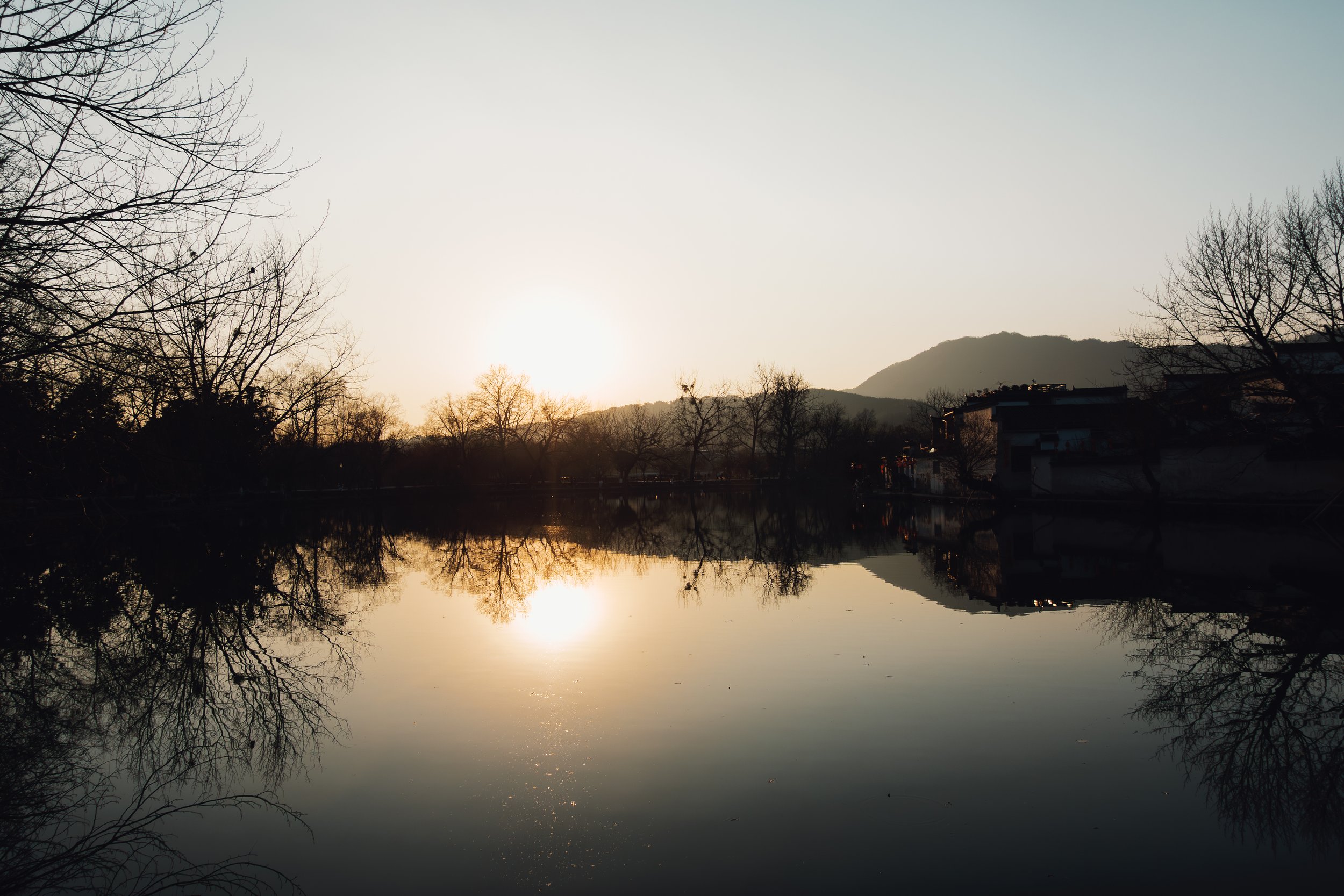
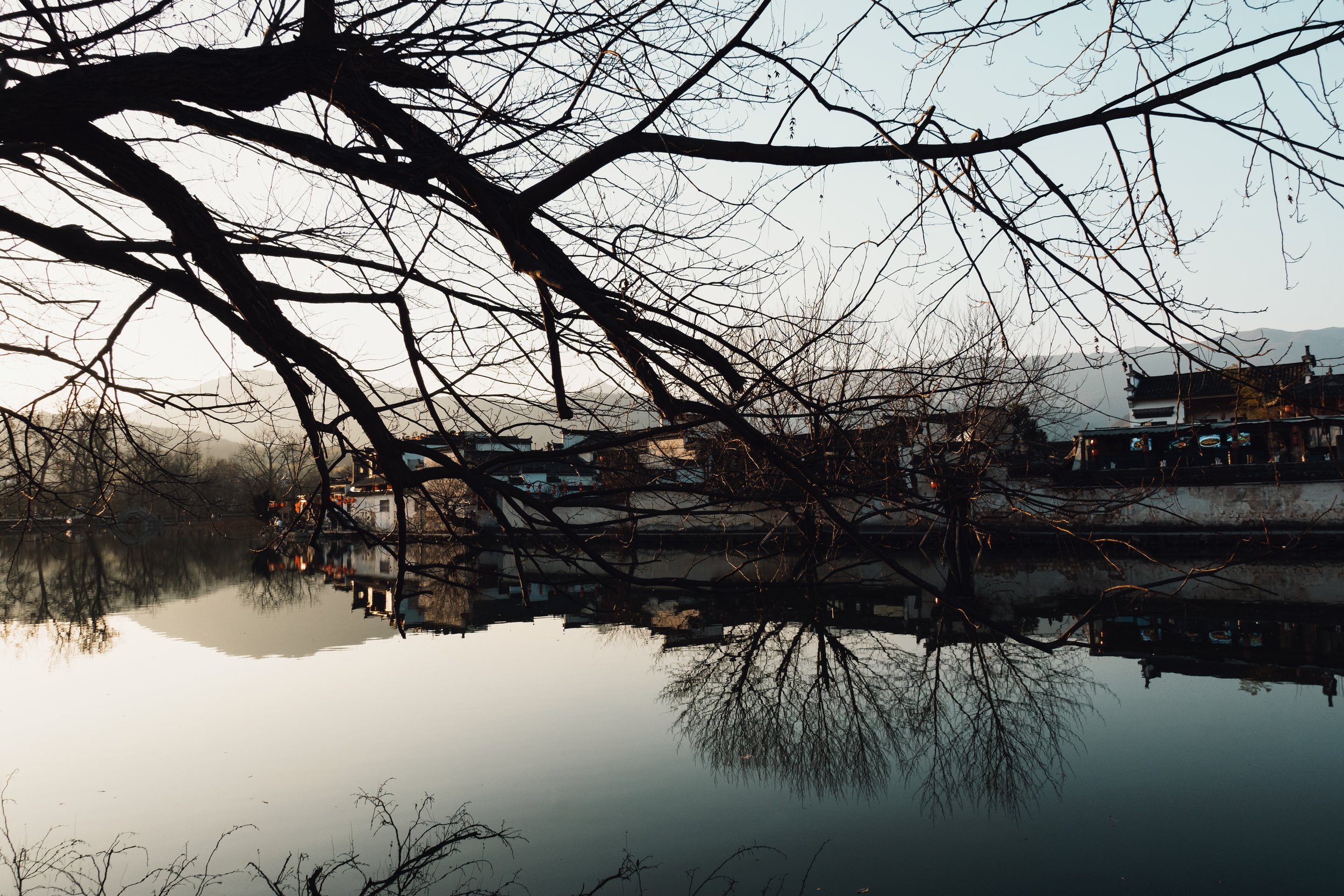
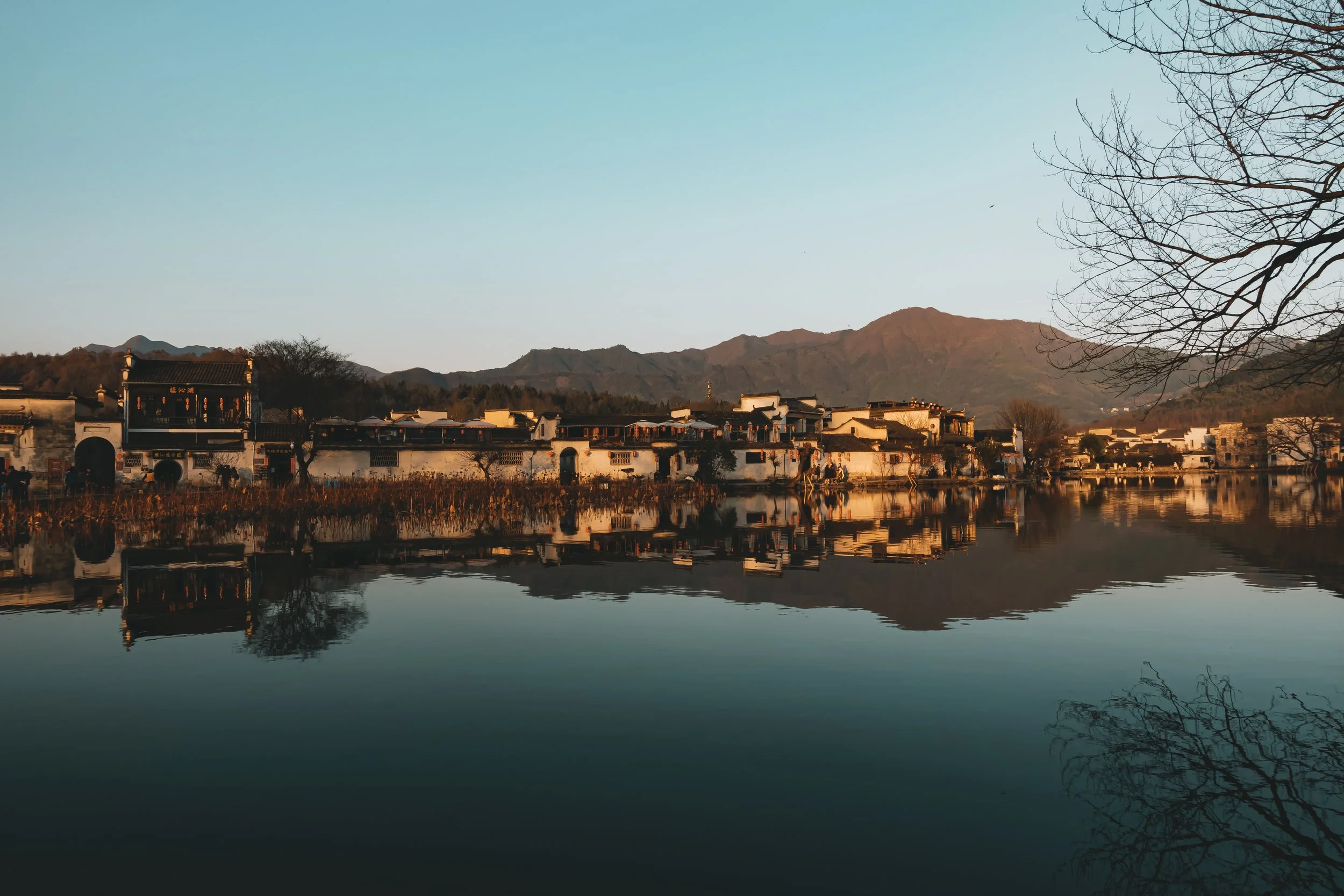

There is a moment, just after sunrise, when the South Lake holds its breath.
The wind that rustled through the willows at dusk has not yet awakened. The ducks that will later trace ripples across the surface are still tucked beneath the eaves of the boathouses. For this one suspended moment, the water is glass—perfect, unbroken, impossibly still.
And then the light arrives.
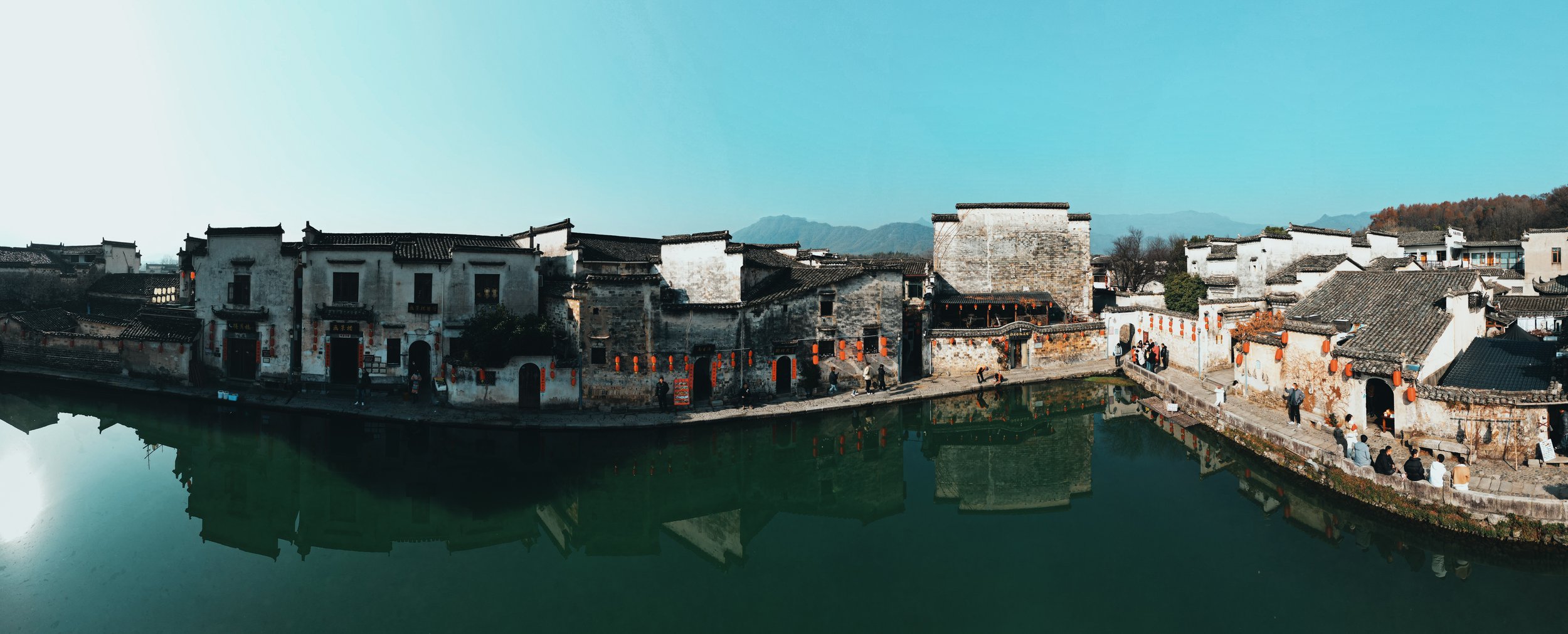
It does not crash over the village; it seeps into it. The first rays slip between the mountains and touch the lake so gently that the water barely shivers. Instead of breaking the reflection, the sunrise deepens it. The sky pours itself into the lake, and suddenly the old town is floating—suspended between a burning sky above and an identical sky below.
To stand at the water's edge at this hour is to witness the world being born again. The reflection is so perfect, so achingly beautiful, that you find yourself speaking in whispers, afraid that sound might shatter the spell.
Sunrise at the South Lake: A Traveler's Ritual.
Set your alarm for 4:30 AM. Dress warmly. Walk through the dark, silent alleys toward the South Lake. Find your spot on the shore. Wait.
The sky will lighten slowly deep blue to pink to gold. The water will mirror every change. The old houses will emerge from darkness, their reflections sharpening as the light grows. And for one perfect hour, you'll have Hongcun to yourself.
This is the traveler's reward. This is why you came.
Where Crouching Tigers Once Walked.
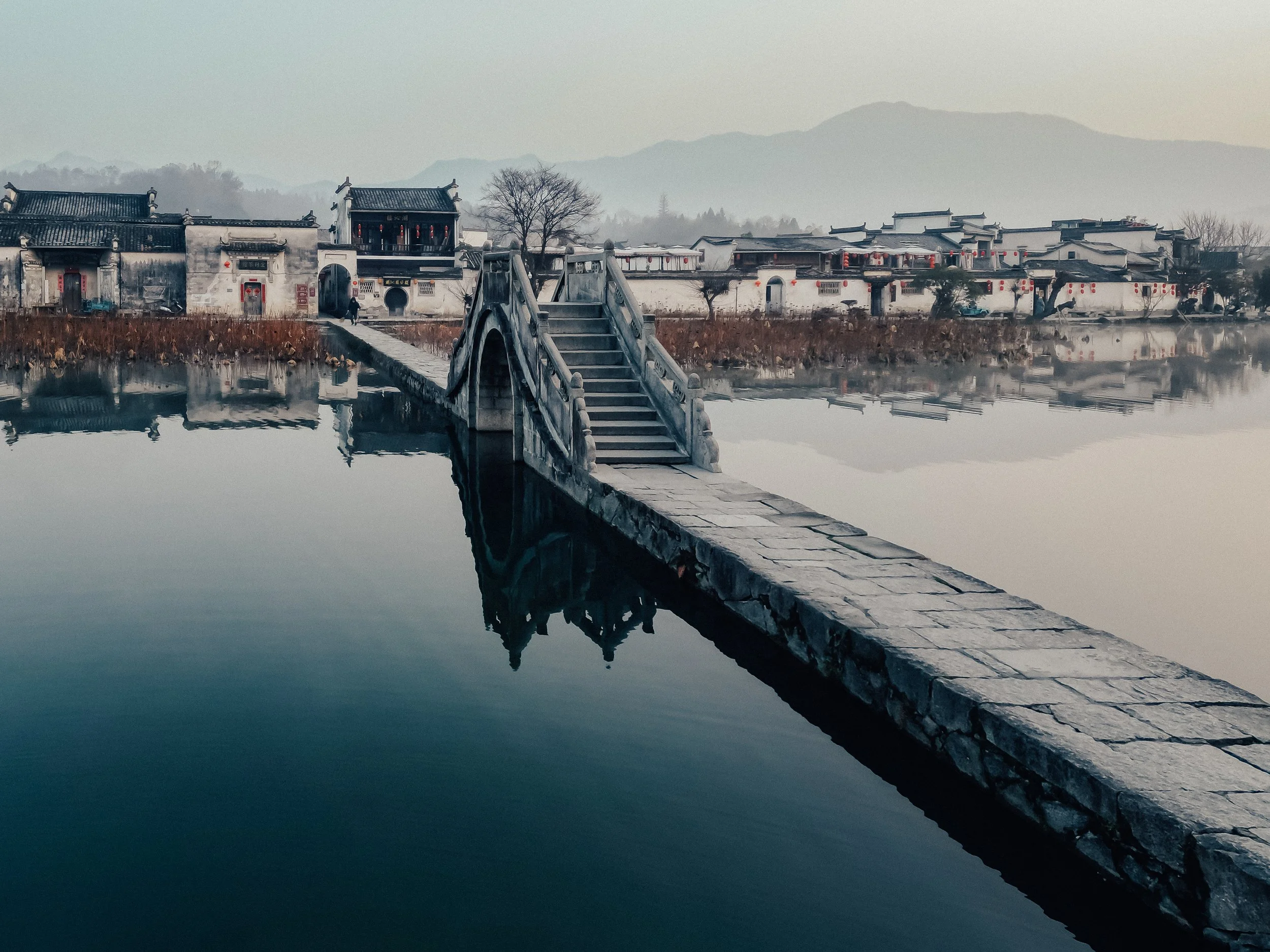
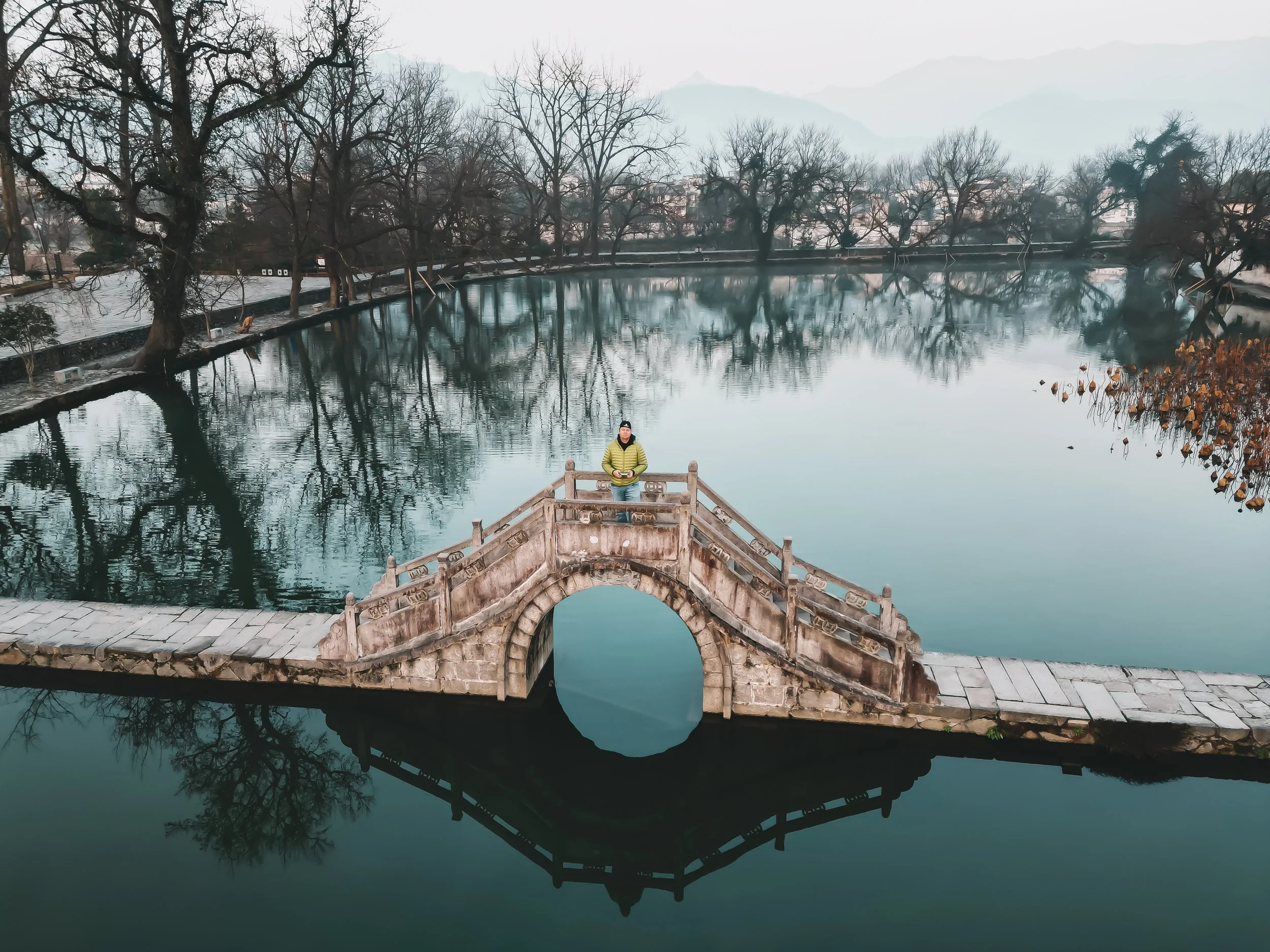
This is the bridge that cinema built—or rather, the bridge that cinema immortalized.
For fans of Crouching Tiger, Hidden Dragon, this stone arch over the South Lake is instantly recognizable. It was here that Zhang Ziyi's character, Jen Yu, gracefully skimmed across the water in a moment of pure cinematic magic. But even without the movie magic, the bridge holds its own allure.
It serves as the gateway to the old town. As you cross it, the modern world falls away and the Ming Dynasty rises to meet you. On one side lies the road home; on the other, the winding alleys and ancient courtyards of a village that has barely changed in 900 years. Step onto the stones, and you step into history.
The bridges of Hongcun are more than passageways; they are the vertebrae of the village. Built without mortar, relying purely on the weight and friction of the local granite, they have endured floods, dynasties, and time itself.
Walking the Dragon's Veins.
The Path Less Wide.
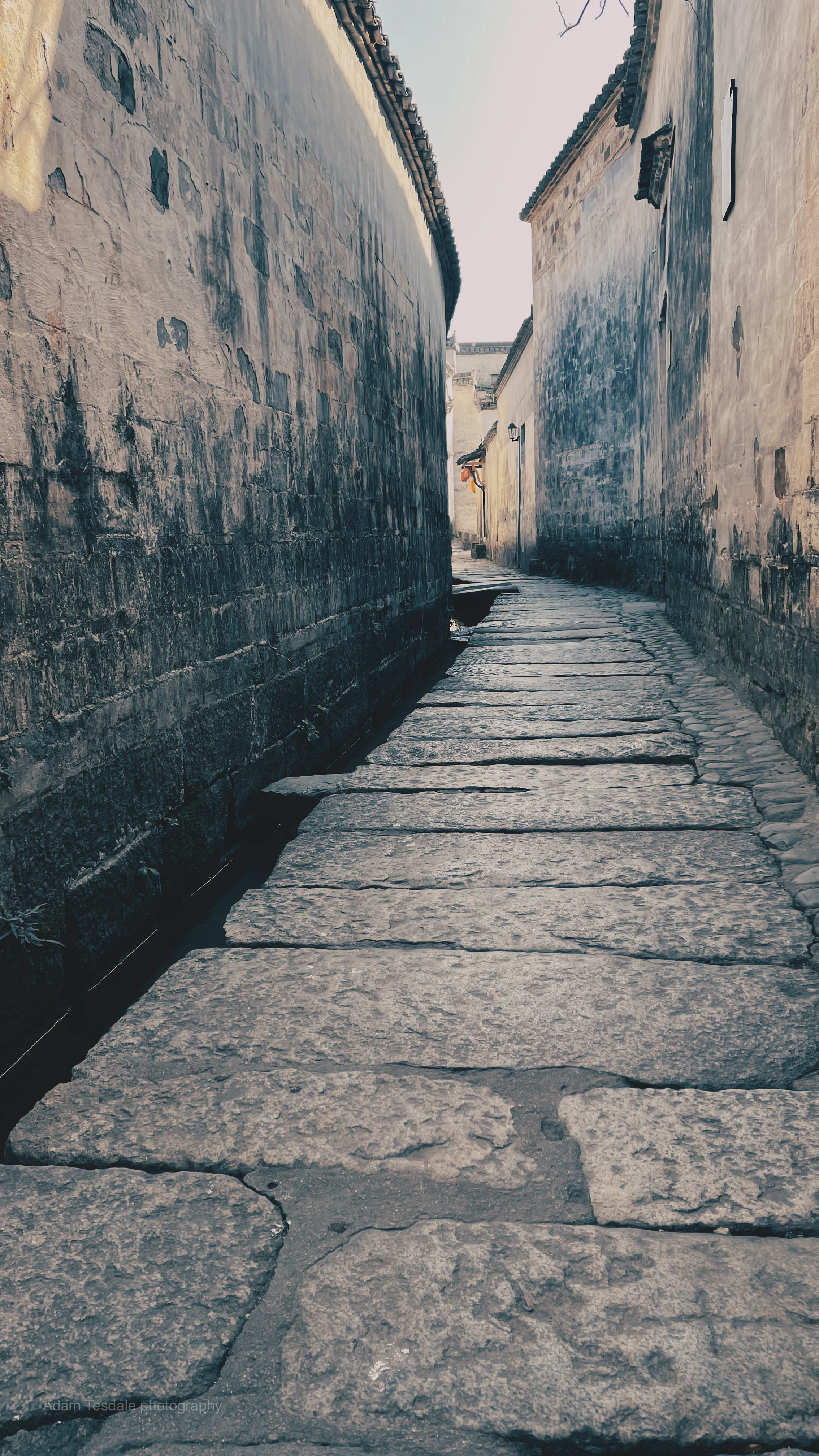
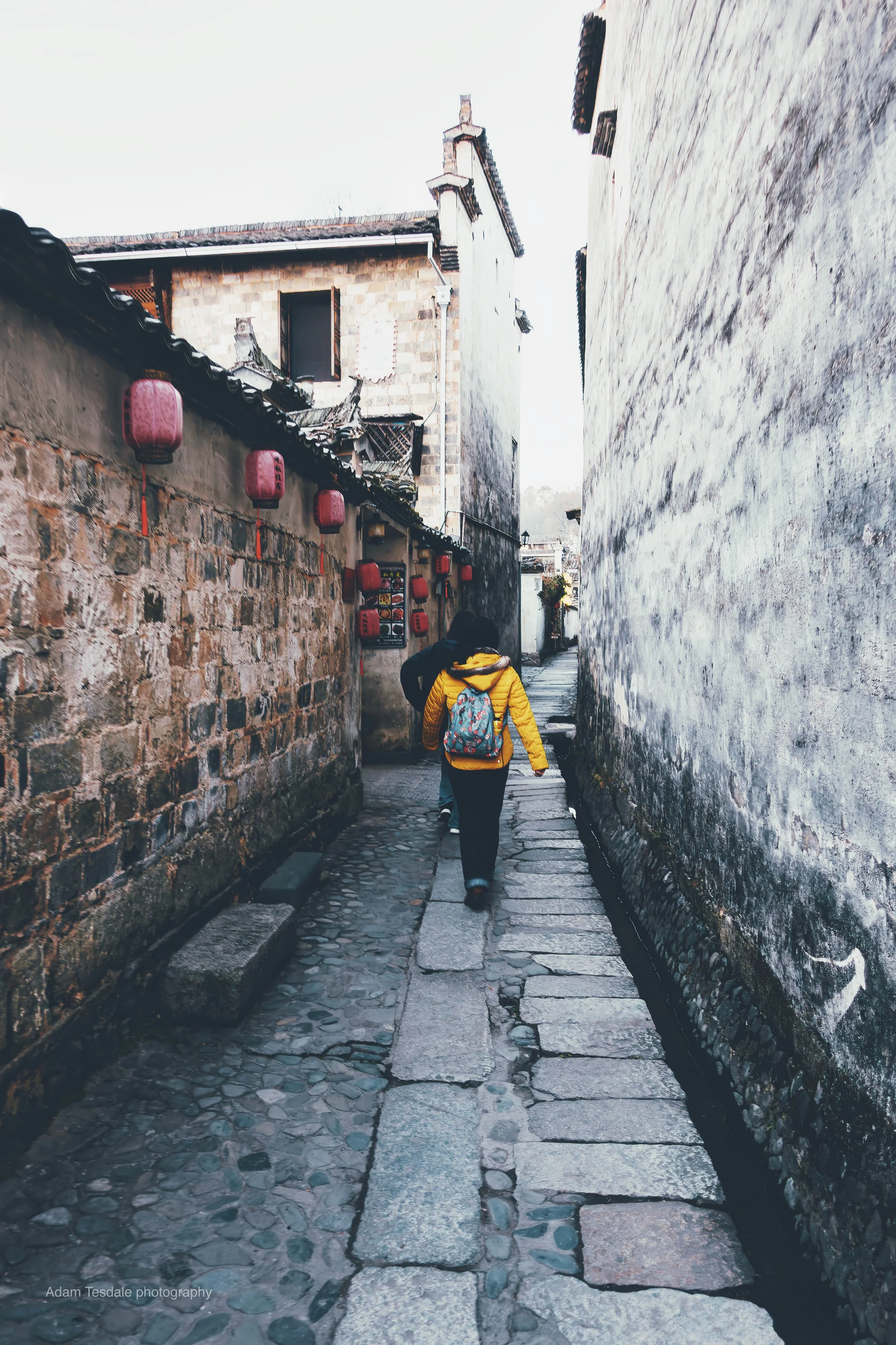
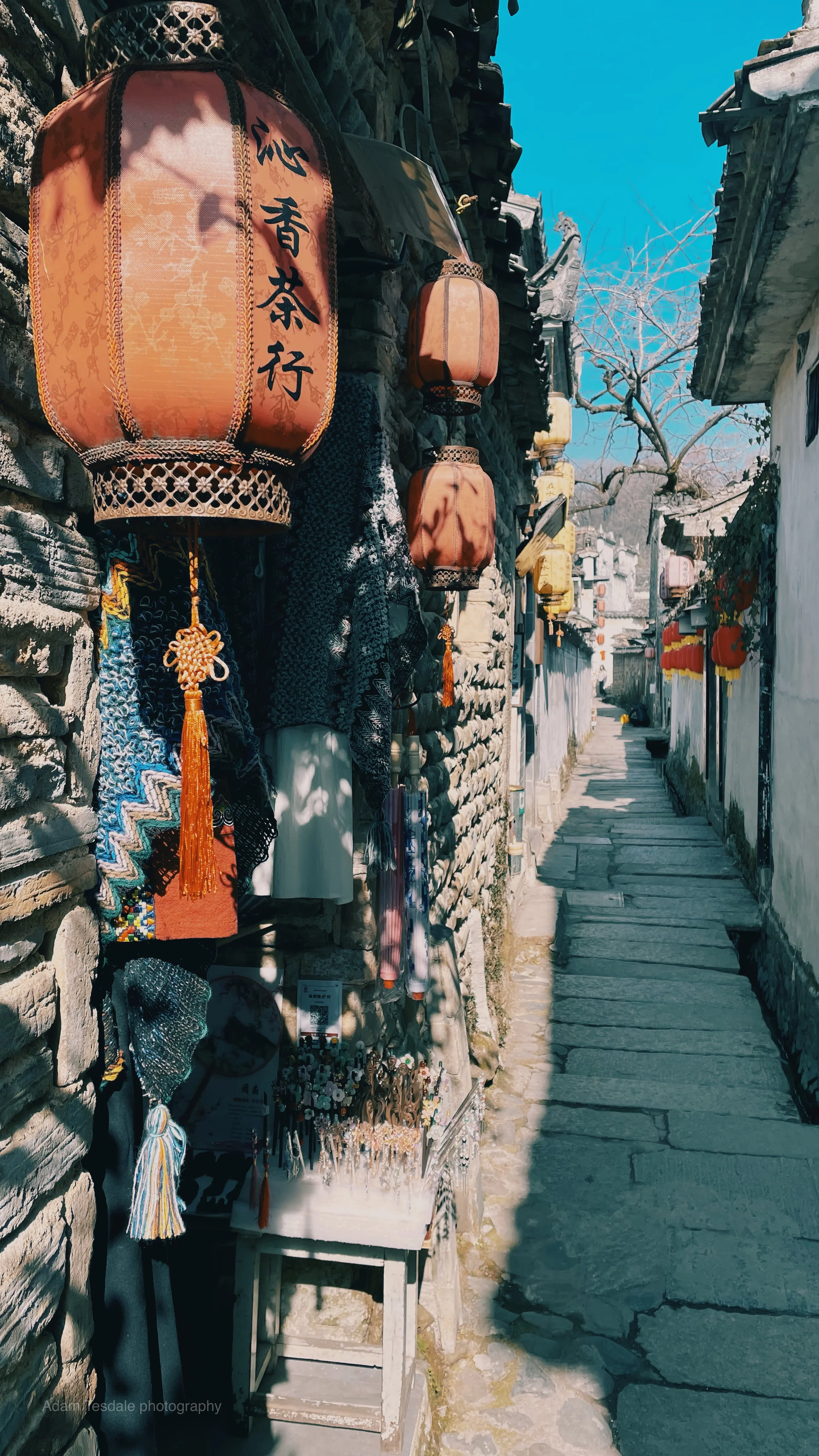
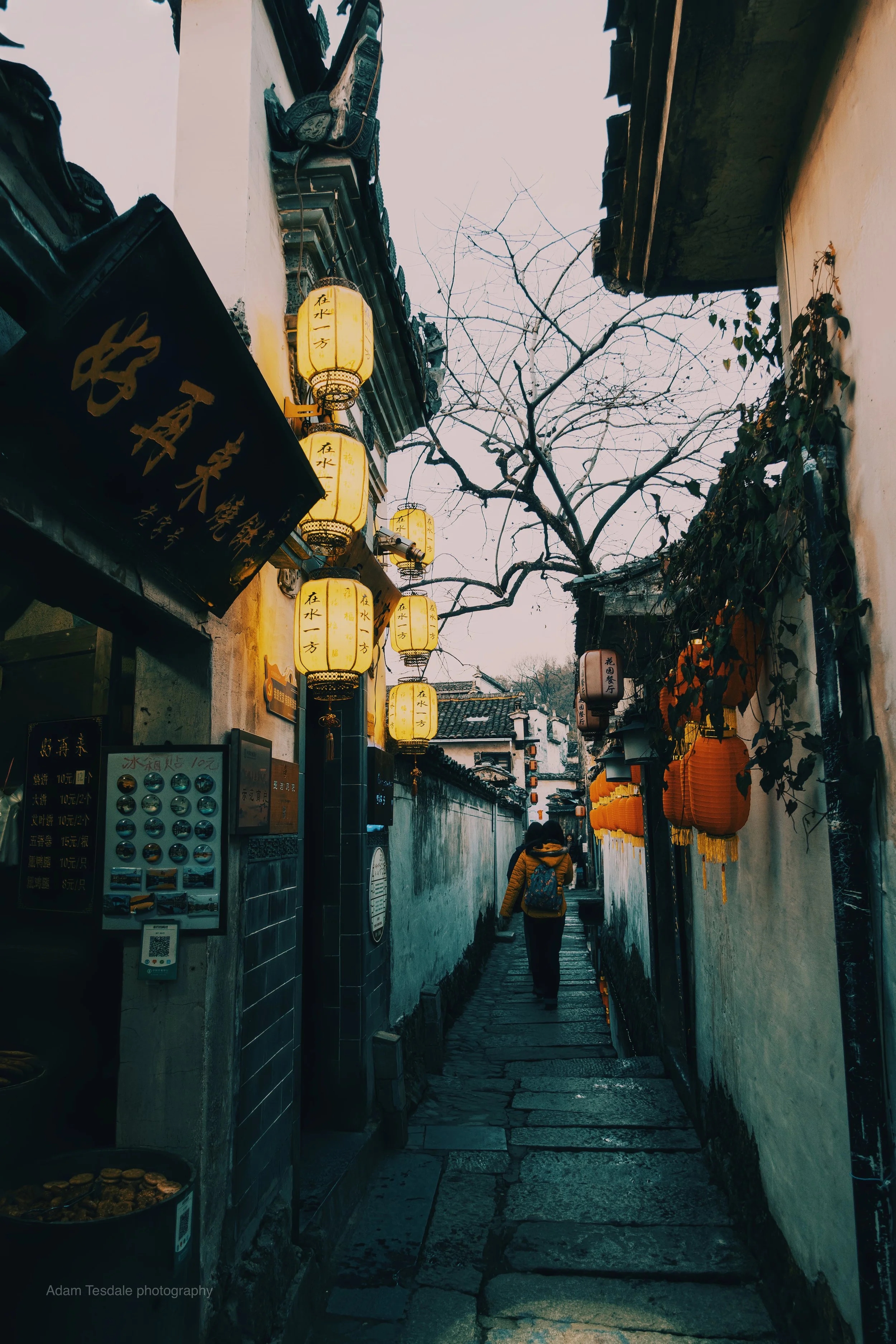
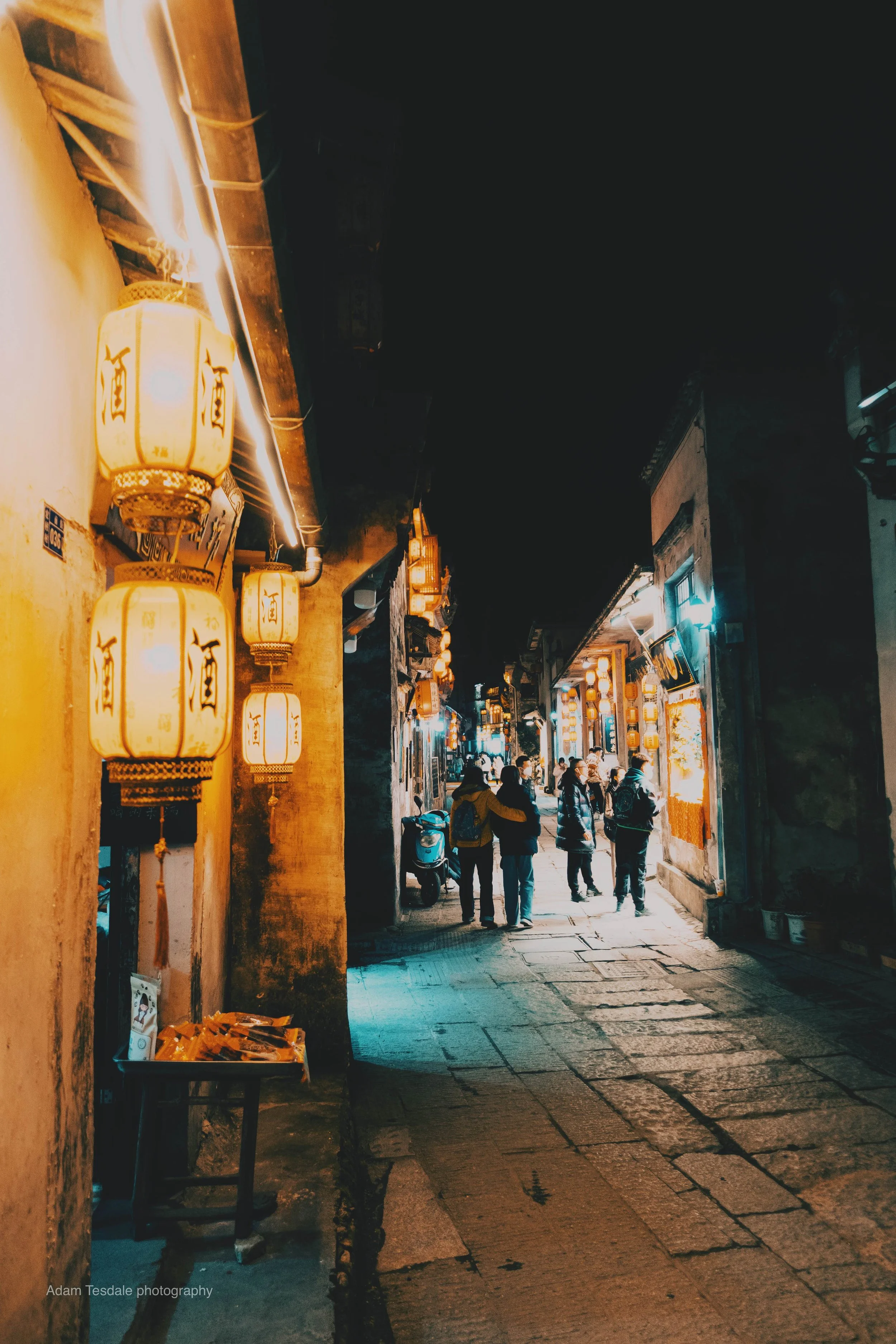
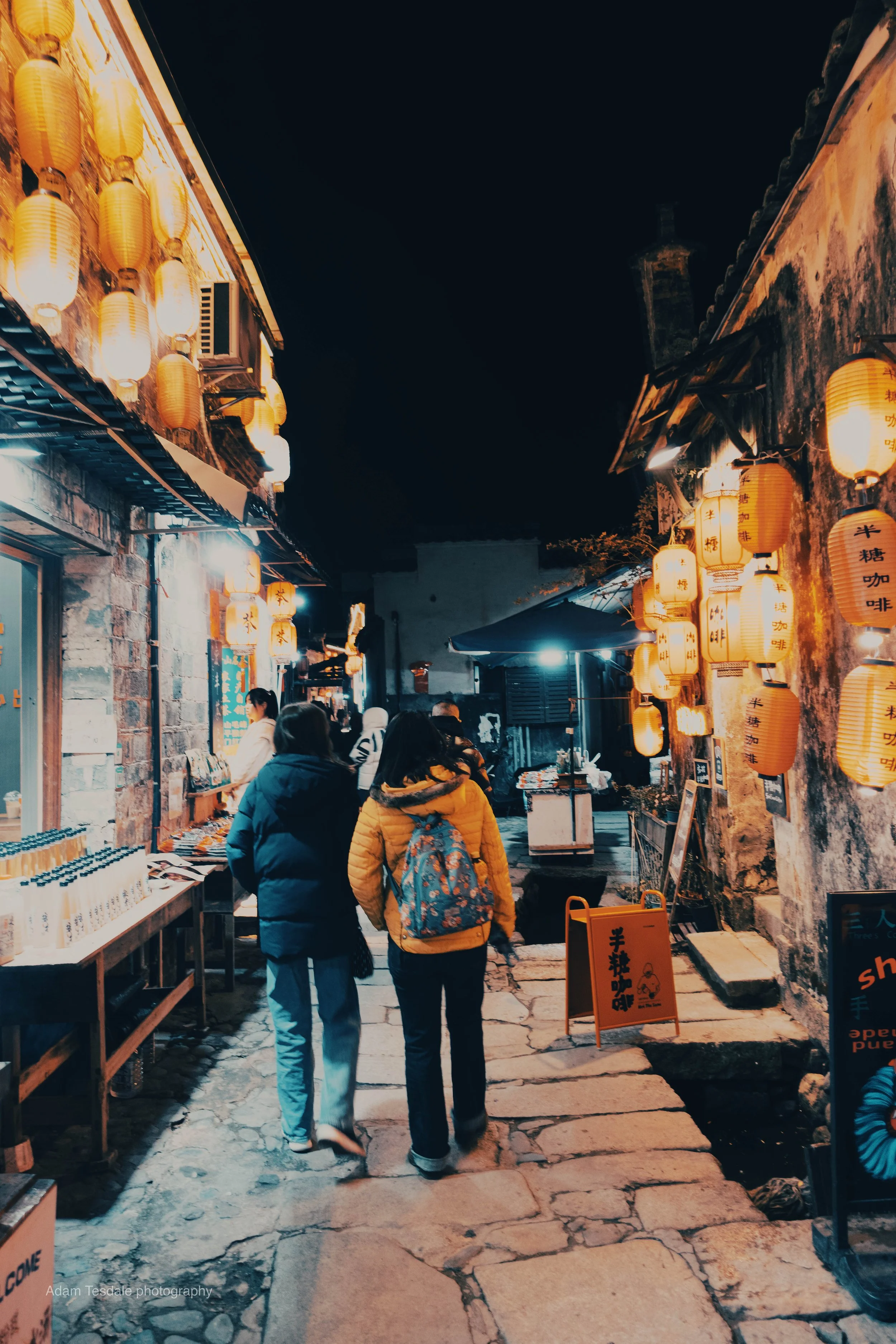
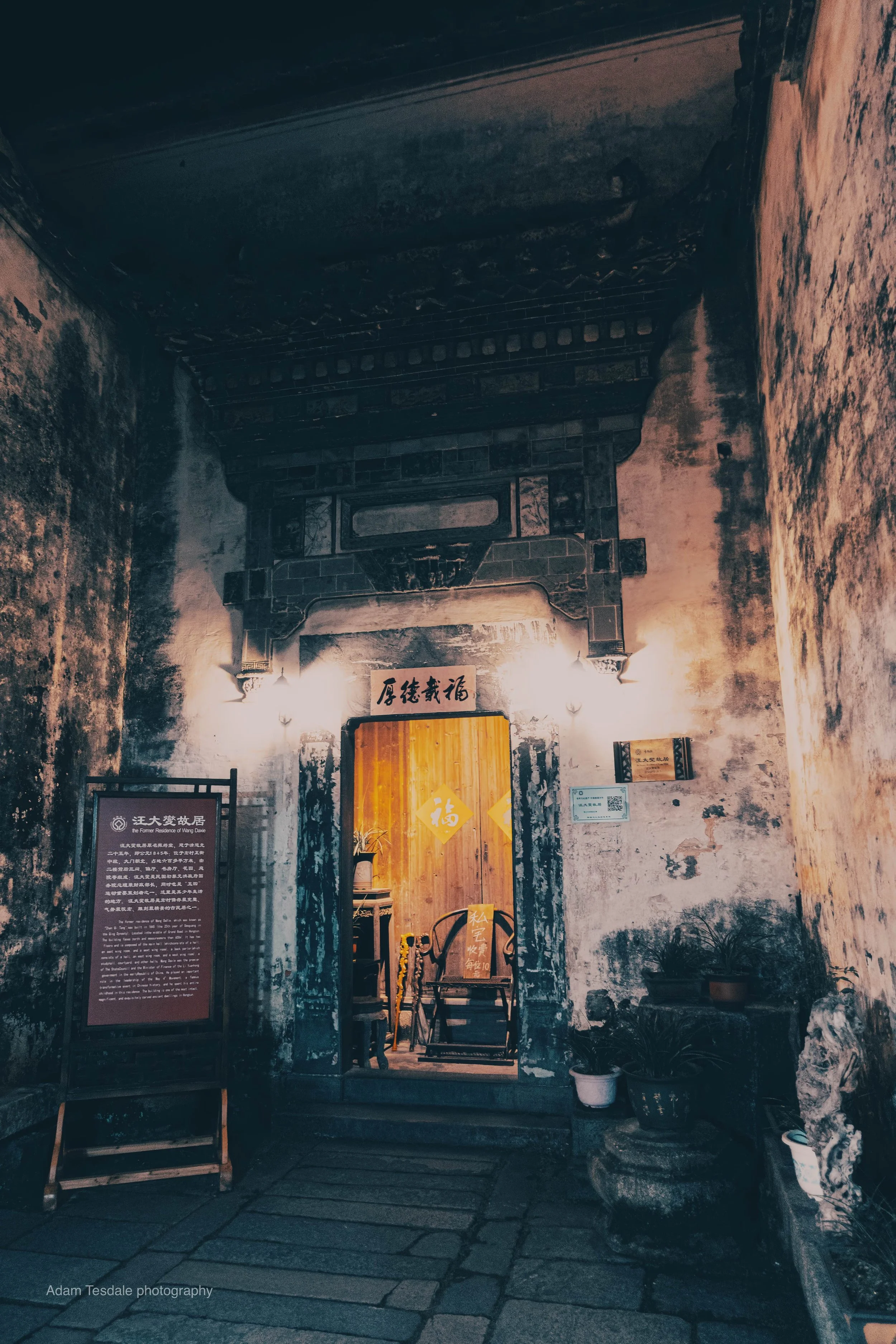
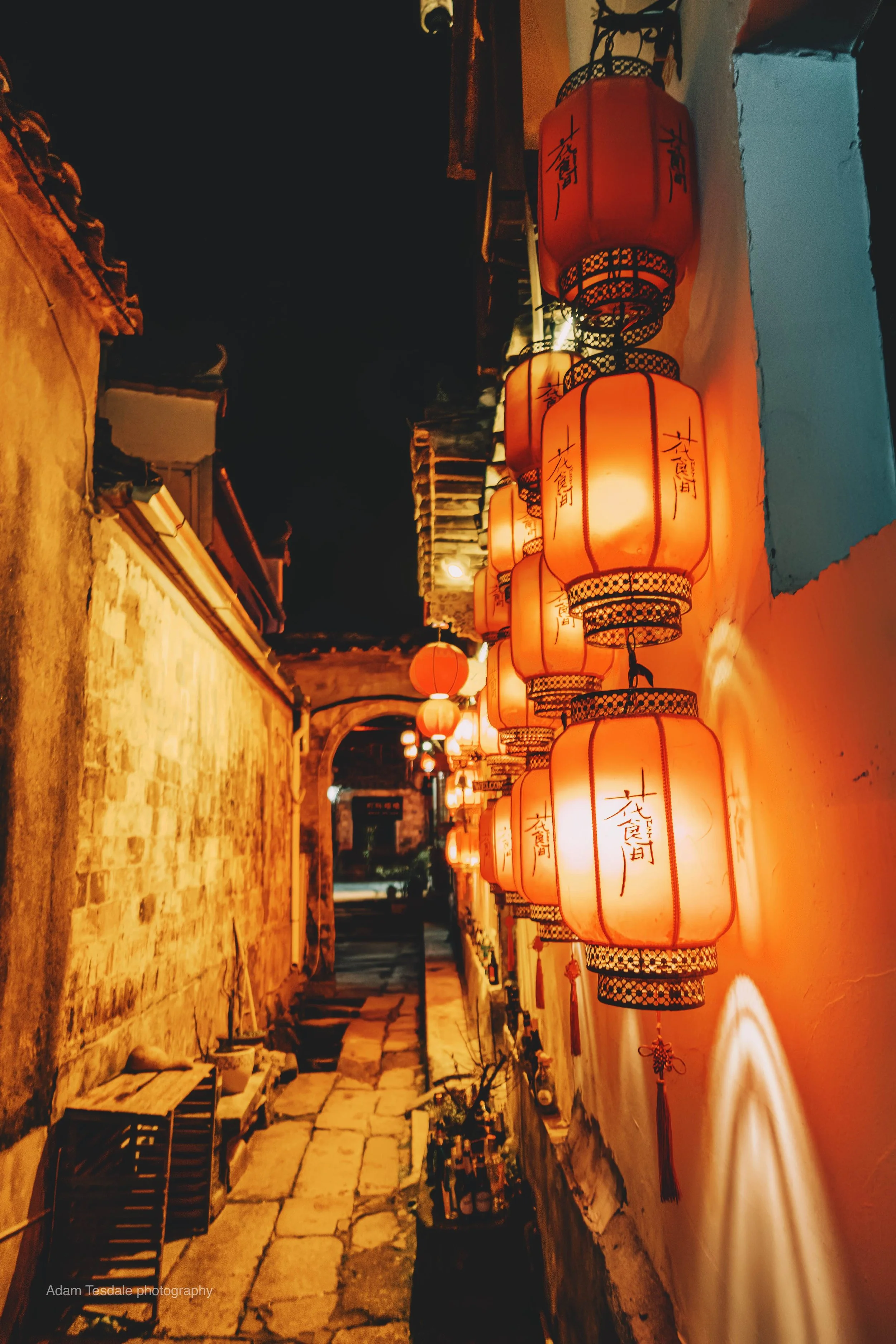
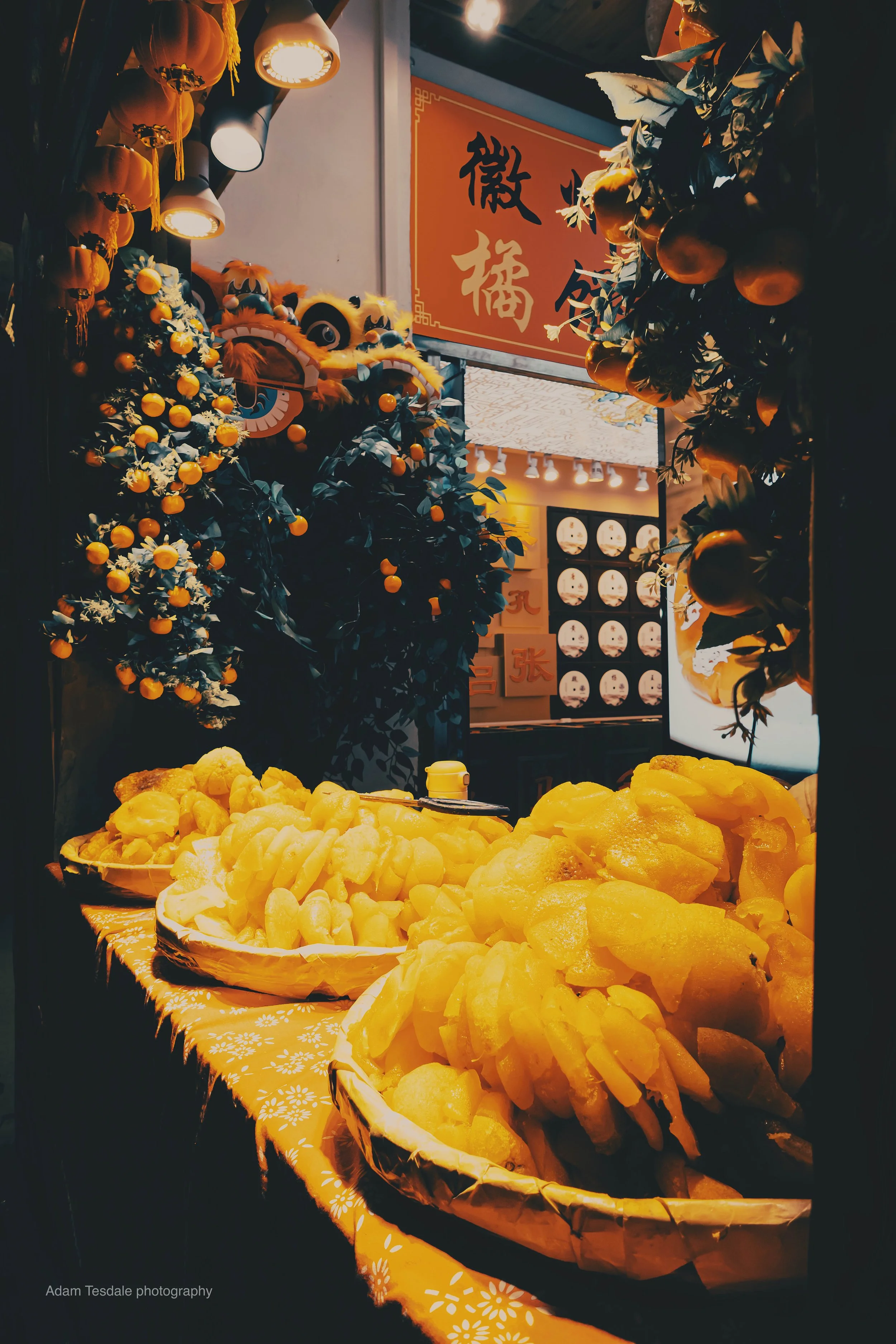
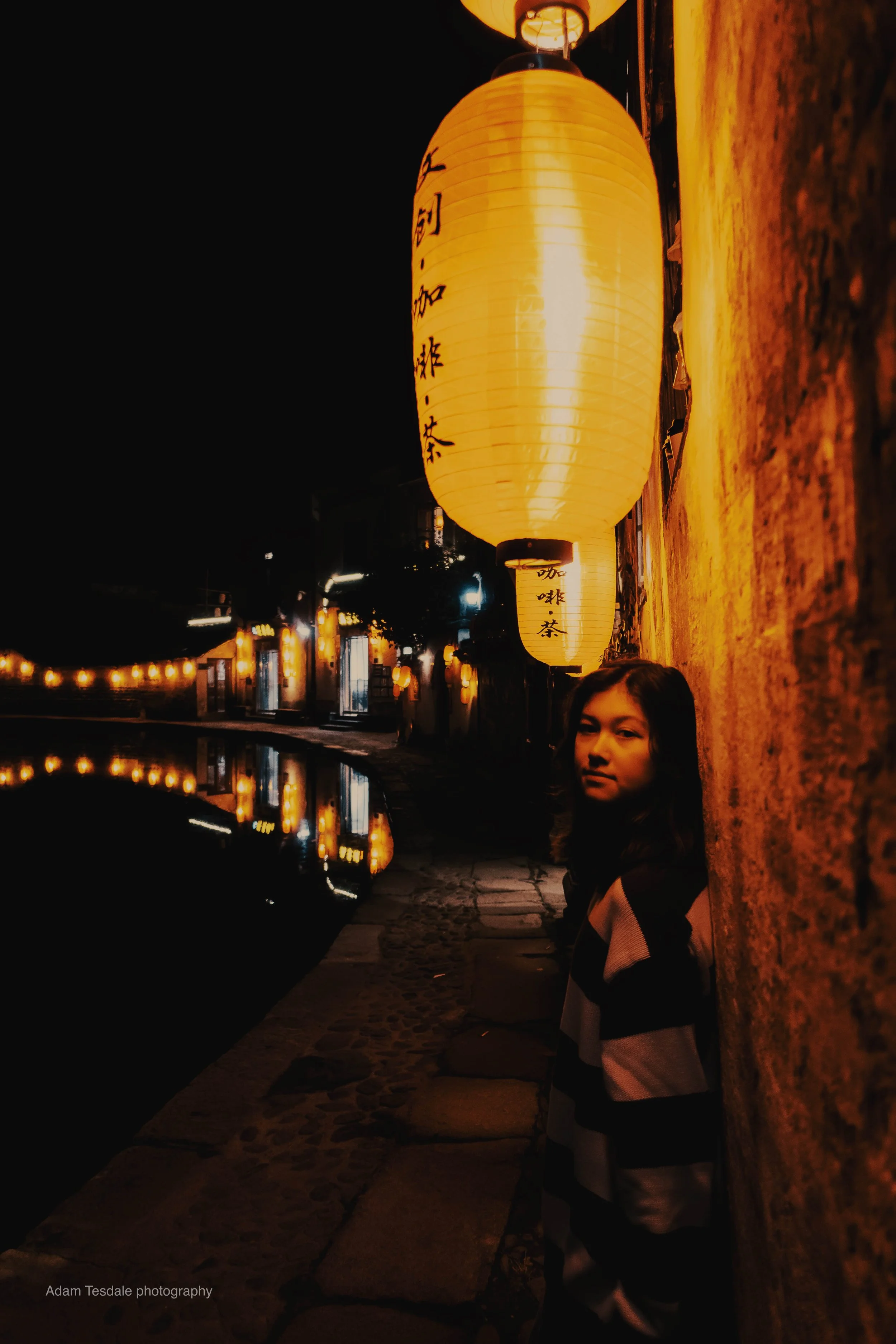
According to the feng shui masters who designed this village in the Ming Dynasty, the layout mimics the anatomy of an ox—but the winding alleys feel more like veins, carrying life to every corner of the organism. At their heart flows the water, the famous canal system that brings fresh mountain streams past every home.
Notice how the streets widen and narrow without warning. This was intentional. The sharp turns and staggered doorways were designed to confuse evil spirits, who were believed to travel only in straight lines. It worked for the spirits—and it works for time itself, which seems unable to find a straight path through these alleys either.
The paving stones tell their own story. Look closely and you'll see the variety: rough-hewn granite from the local mountains, smoother river stones carried from the streams, occasional flagstones worn to a mirror finish by centuries of use. Between them, moss and ferns take root in the damp seams, softening the hard edges of history.
Above, the walls rise two stories, their white plaster patched and stained. The roofs tilt inward, their black tiles forming a jagged silhouette against the sky. At night, when the red lanterns glow and the last light fades from the ribbon of sky above, the alleys become something else entirely—a dream you walk through, half believing you might step back into the Ming Dynasty with every stride.
The Taste of Coming Winter.
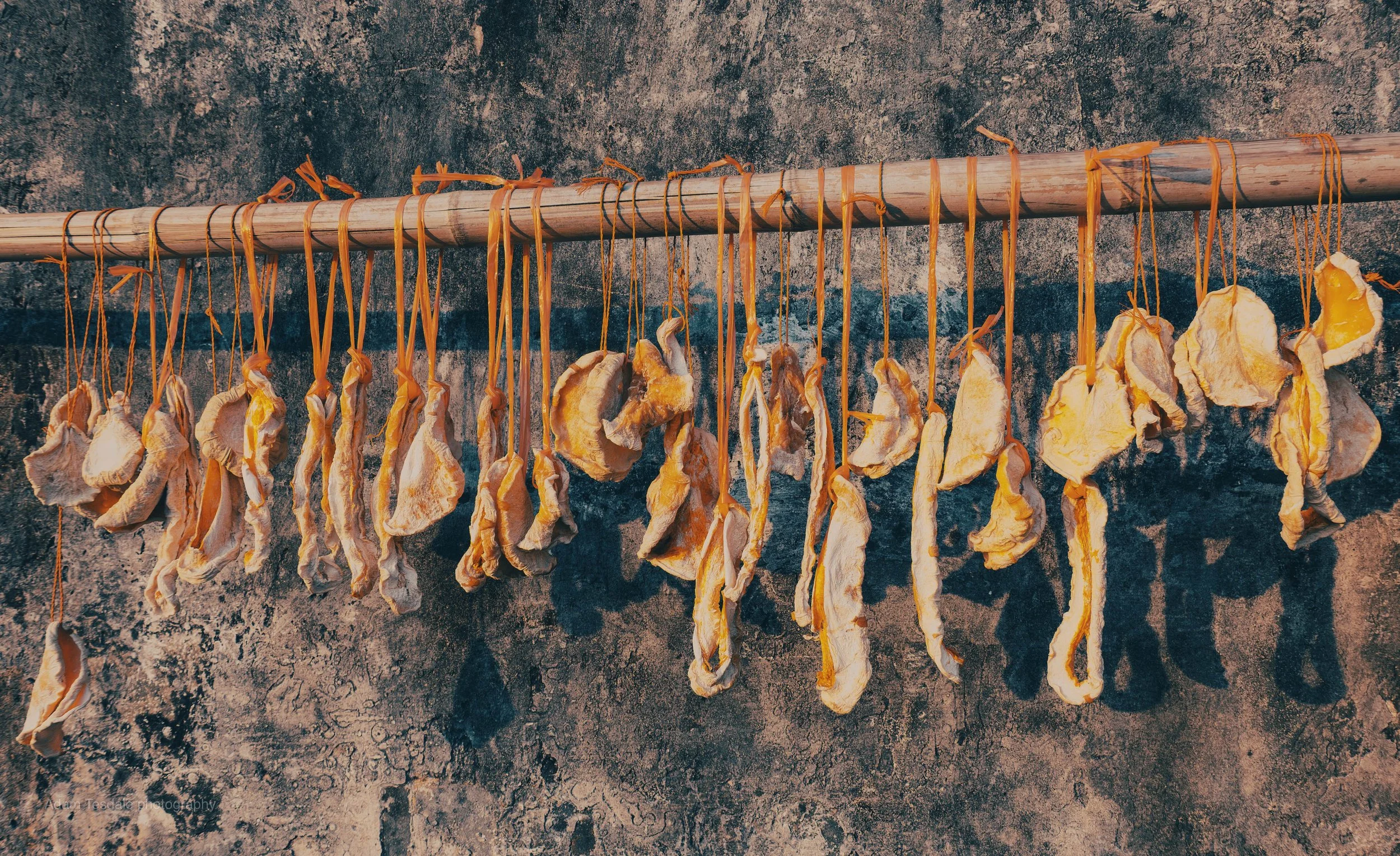
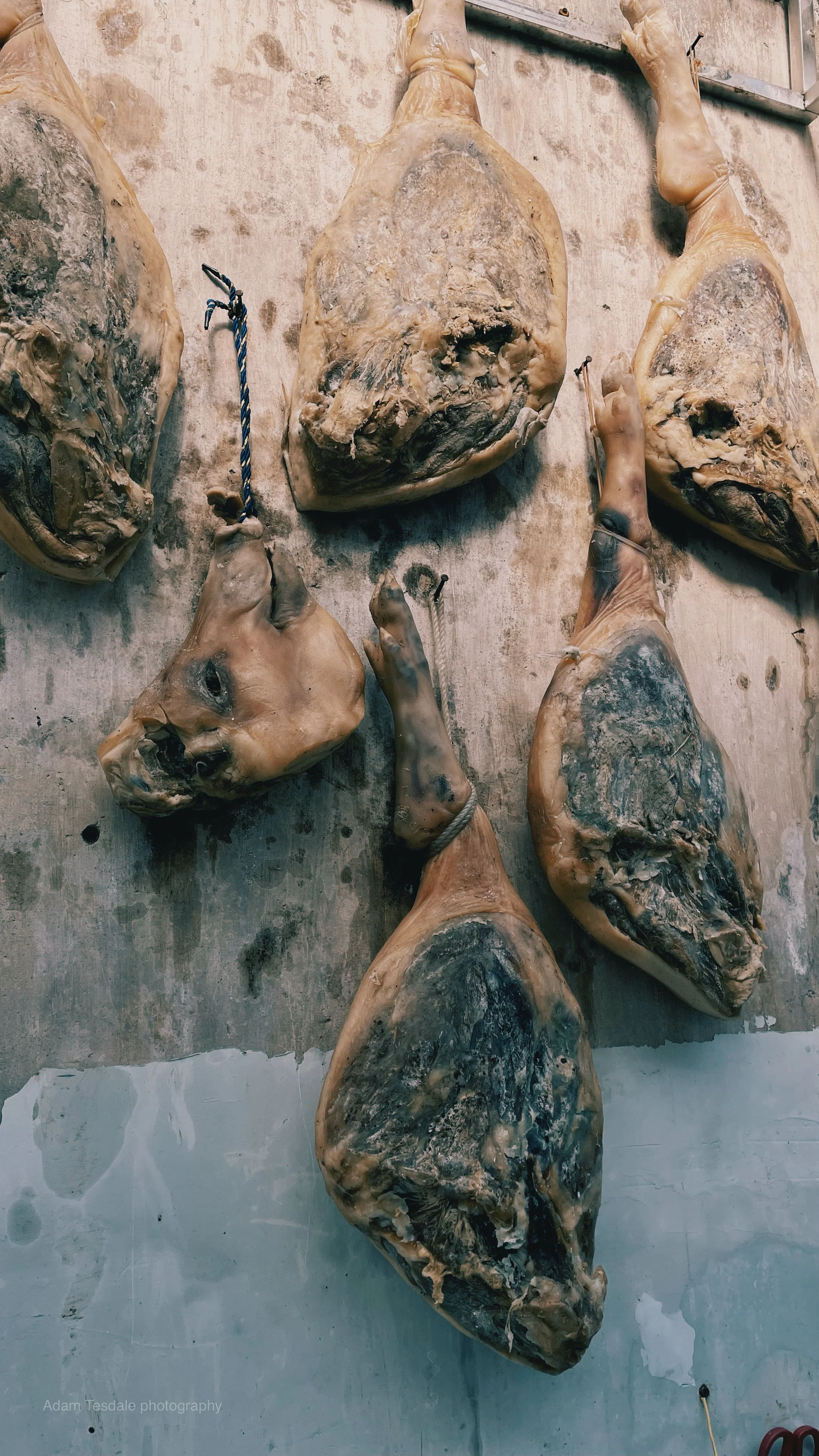
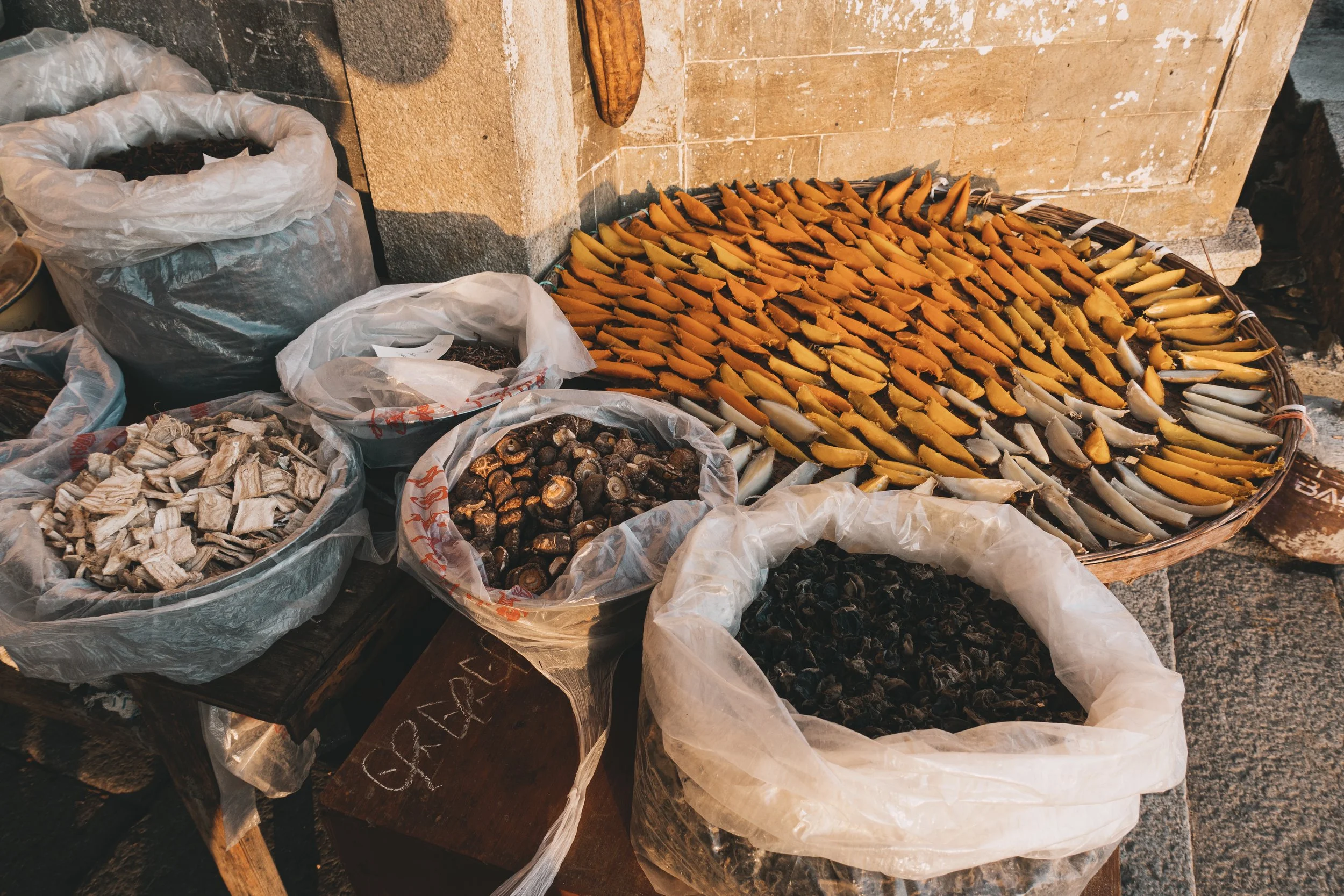
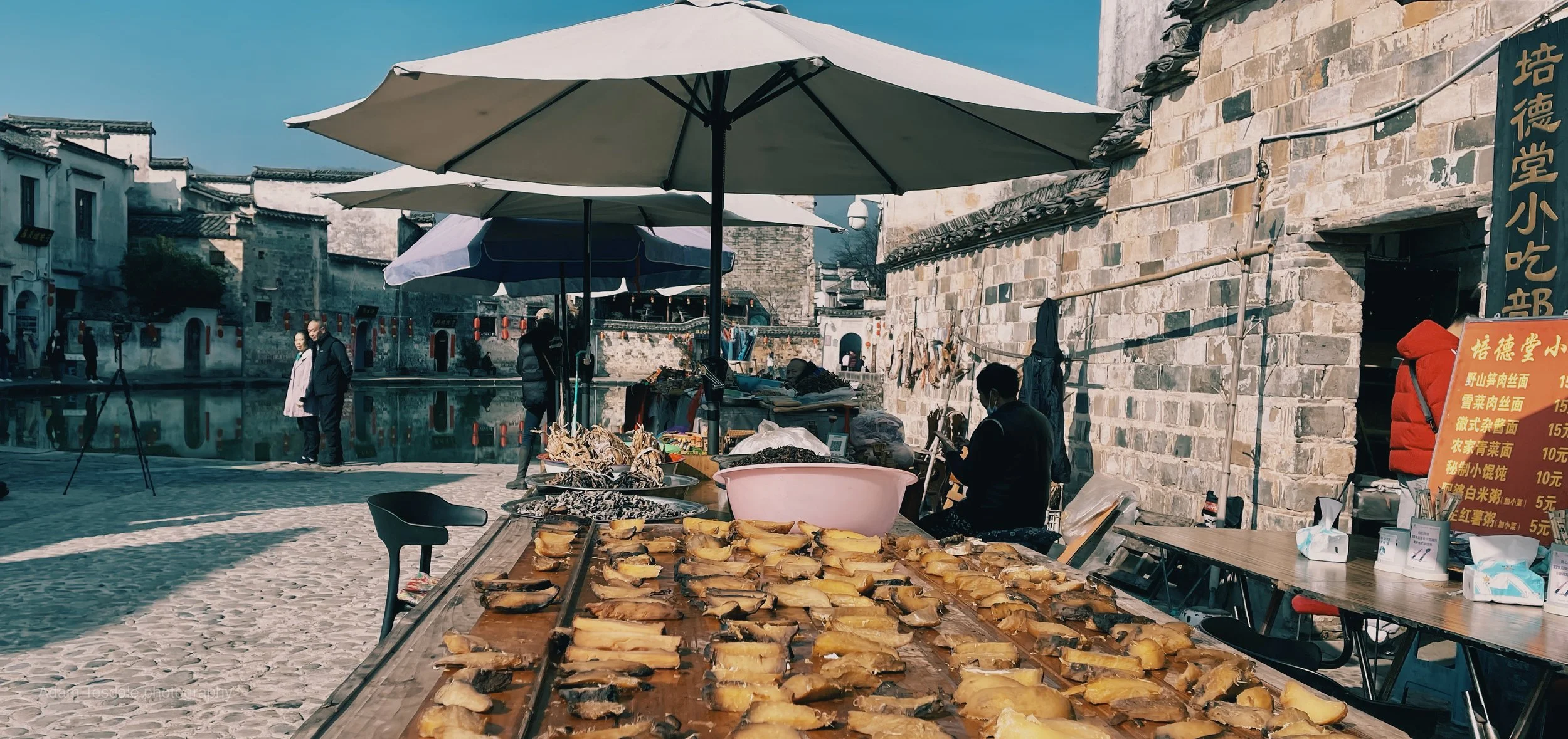
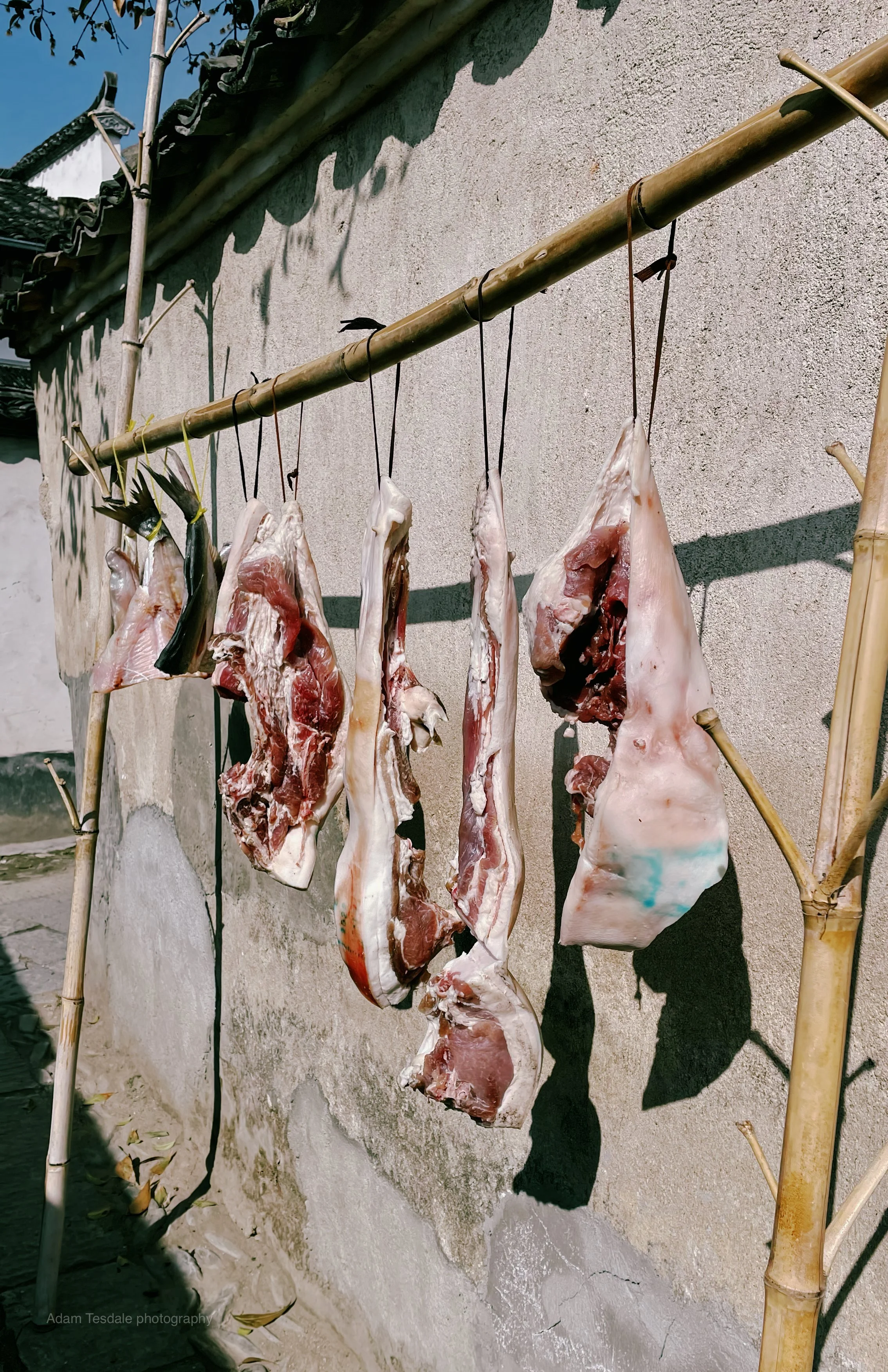
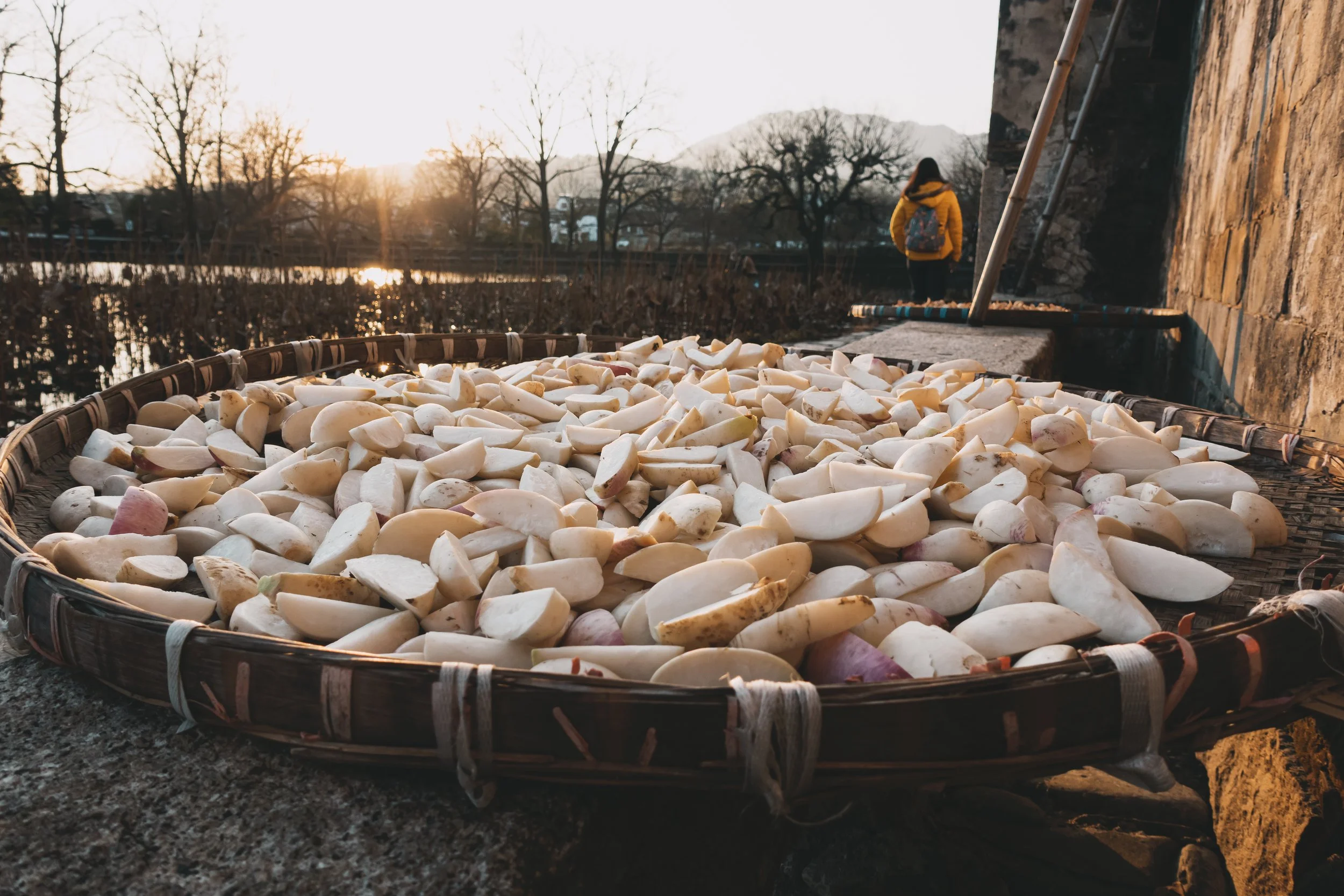
Walk through Hongcun in the late autumn, and you'll notice something hanging from every available surface.
The old woman by the canal has arranged sliced lotus root on a bamboo tray—perfect circles of white, like coins waiting to be claimed by the sun. The man repairing nets near the bridge has strung tiny fish on lines, their scales catching the light. On nearly every rooftop, persimmons rest in wooden frames, slowly collapsing into concentrated sweetness.
This is the rhythm of life here. When the harvest comes in, the village transforms into an open-air pantry. The narrow streets, already beautiful with their ancient stone and weathered walls, become something more: a testament to the connection between these people and the land they've worked for centuries.
I watched one woman tend her drying chilies, turning them gently with weathered hands. She smiled when she caught me looking, then gestured toward the sky—a warning, perhaps, that rain was coming, or simply an acknowledgment that we were both watching the same sun, waiting for it to do its work.
The food drying in Hongcun is more than preparation for winter. It is a conversation between generations, a ritual repeated thousands of times, a way of saying: We are still here. We still know how to live from the land. We still remember.
Ancient Streets, Fresh Brew
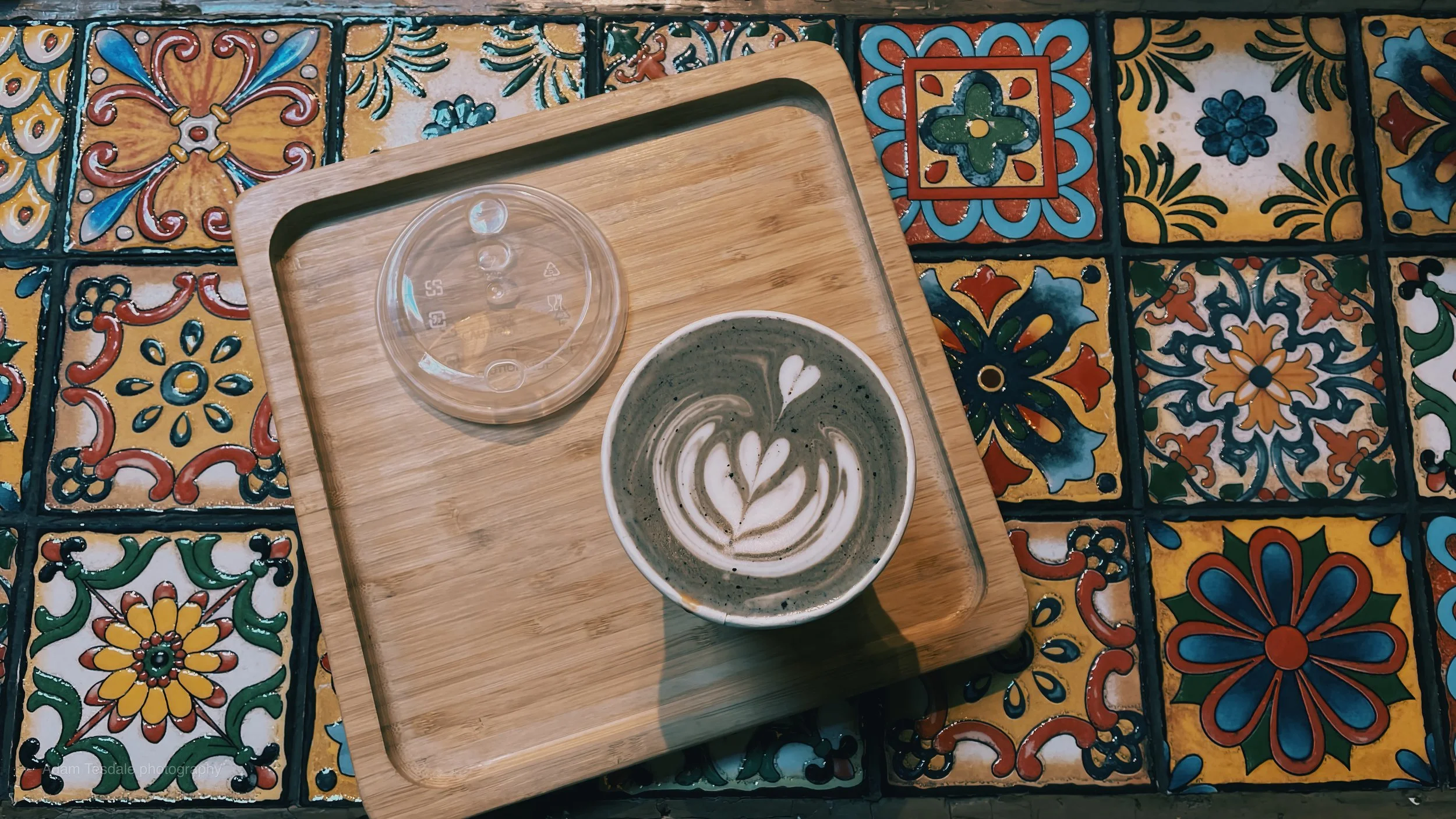
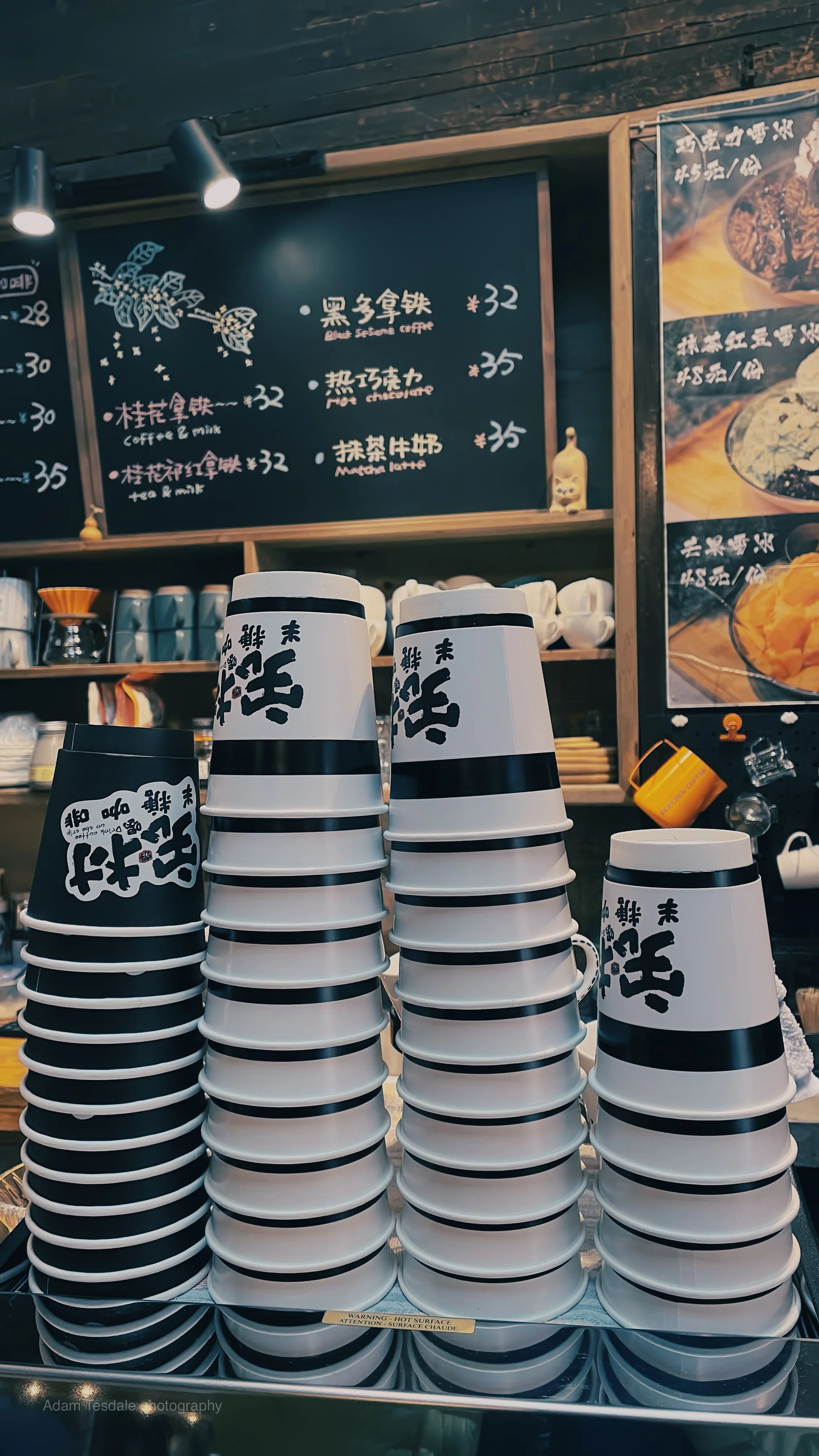
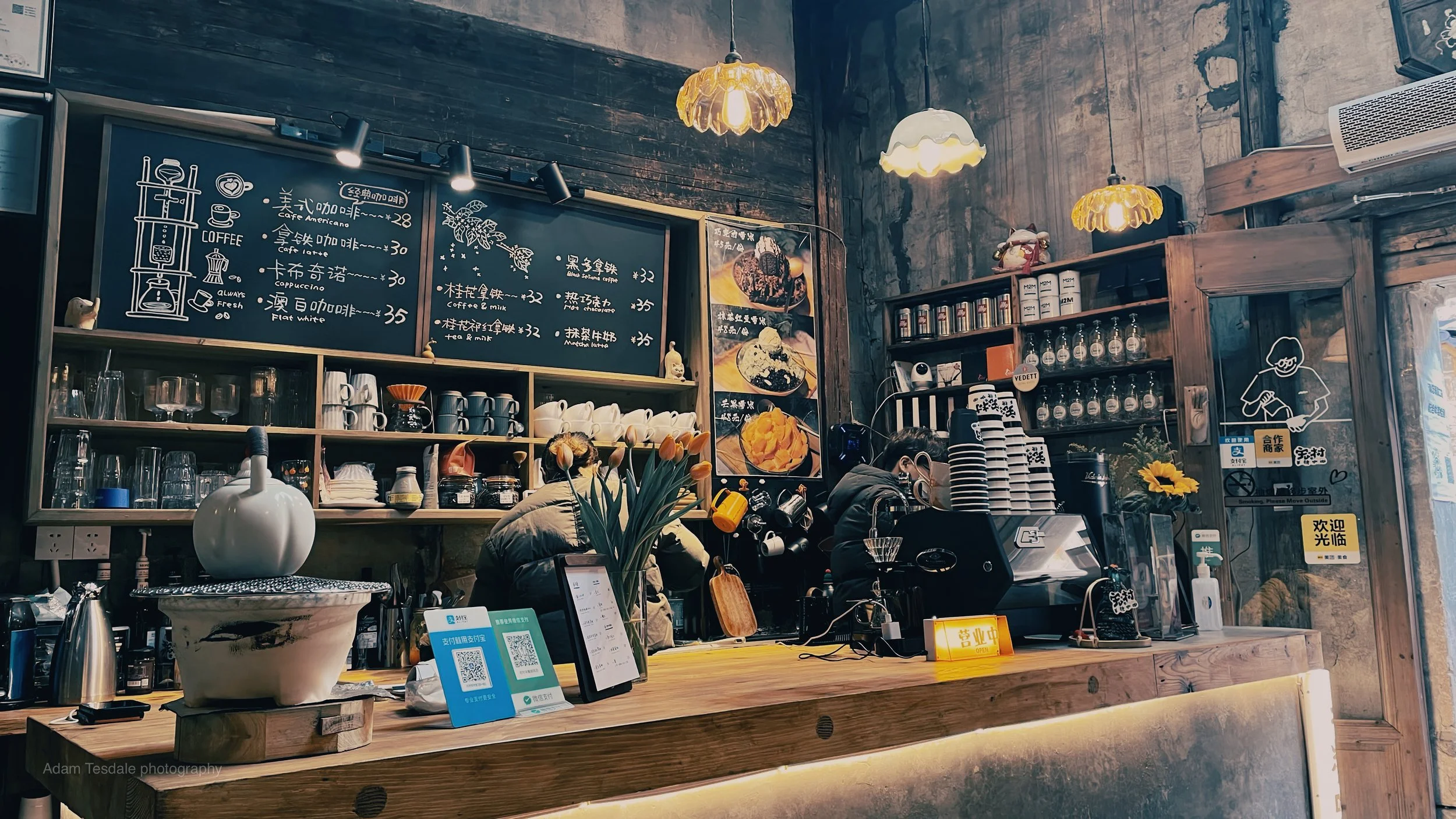
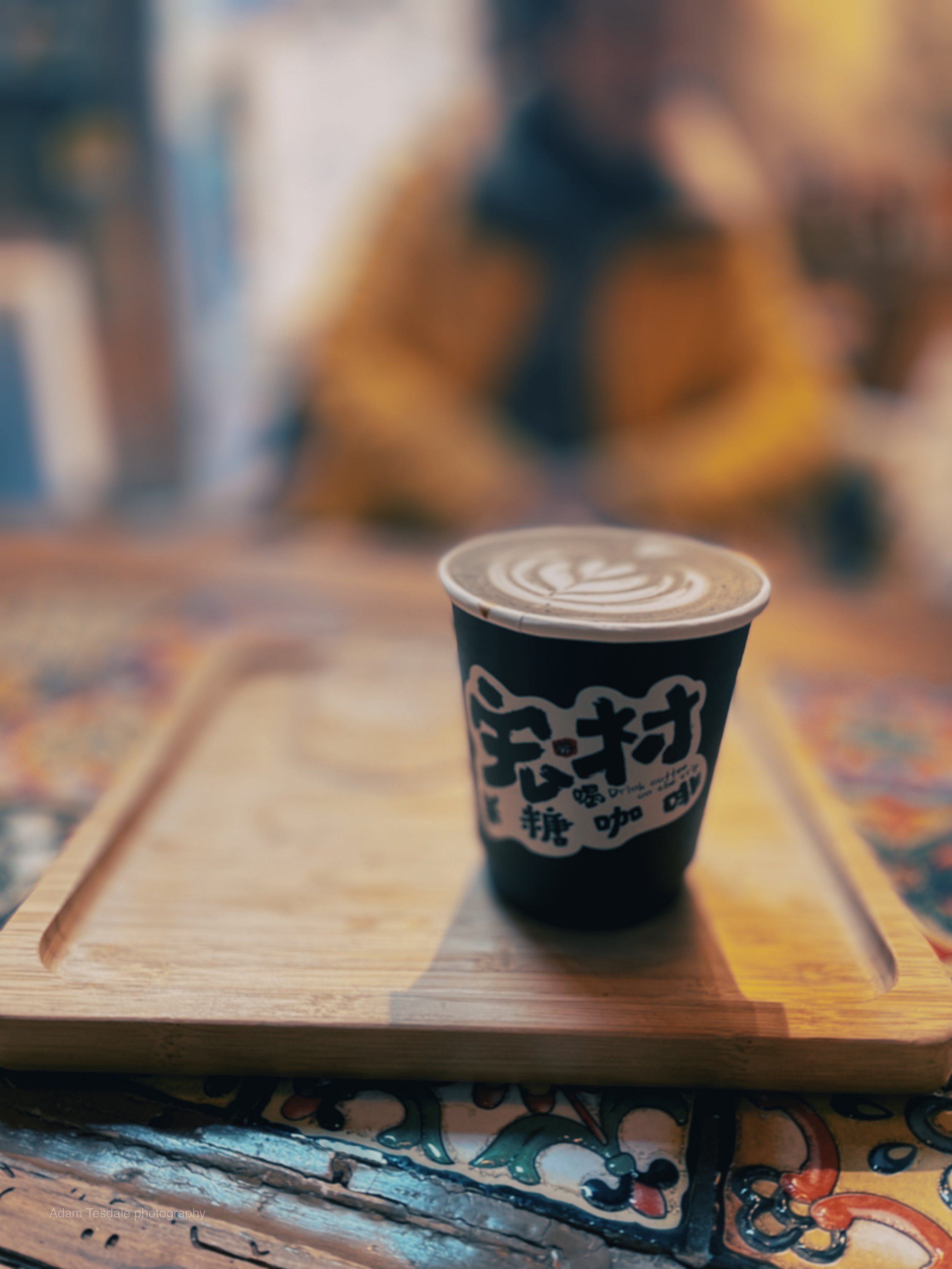
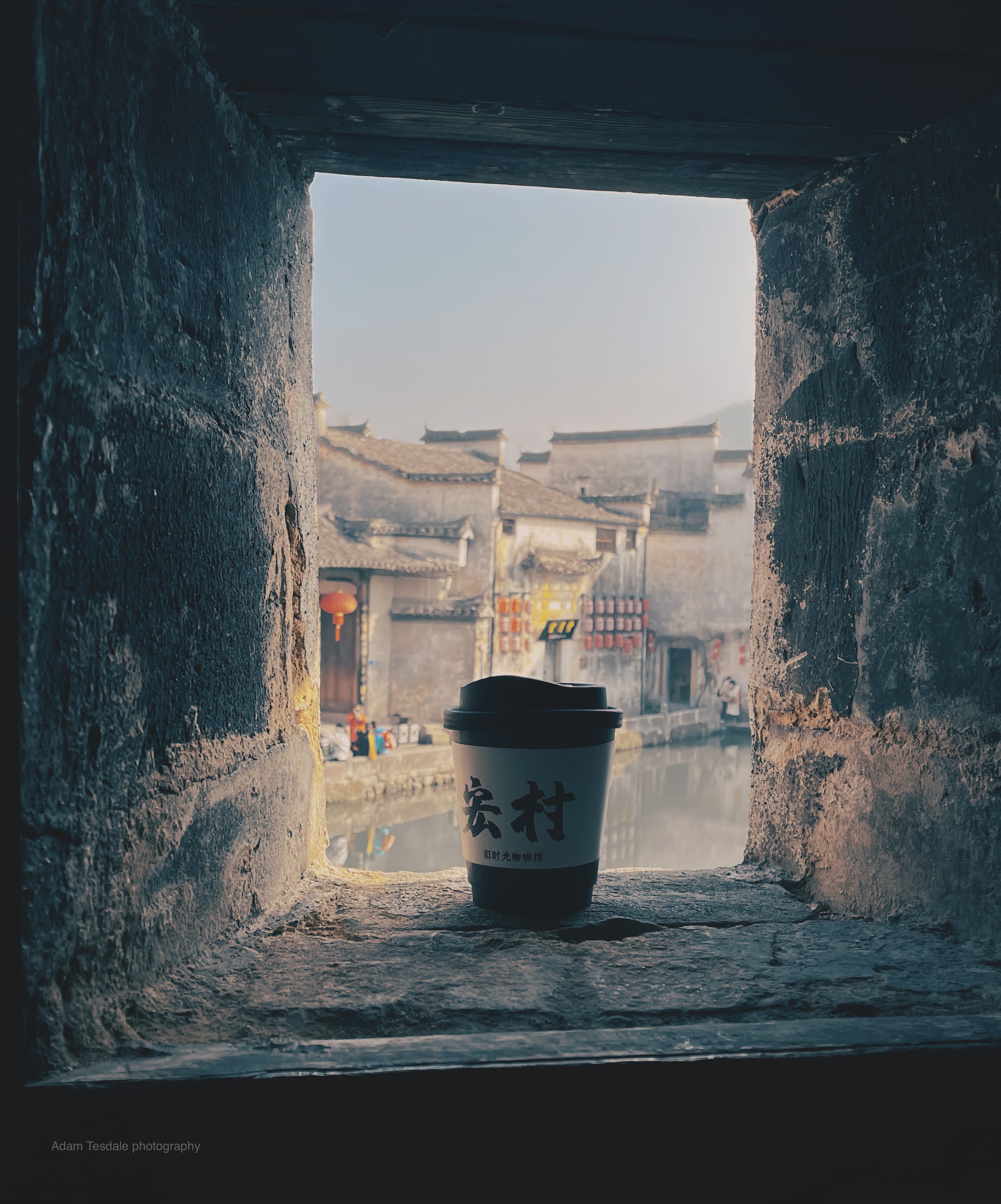
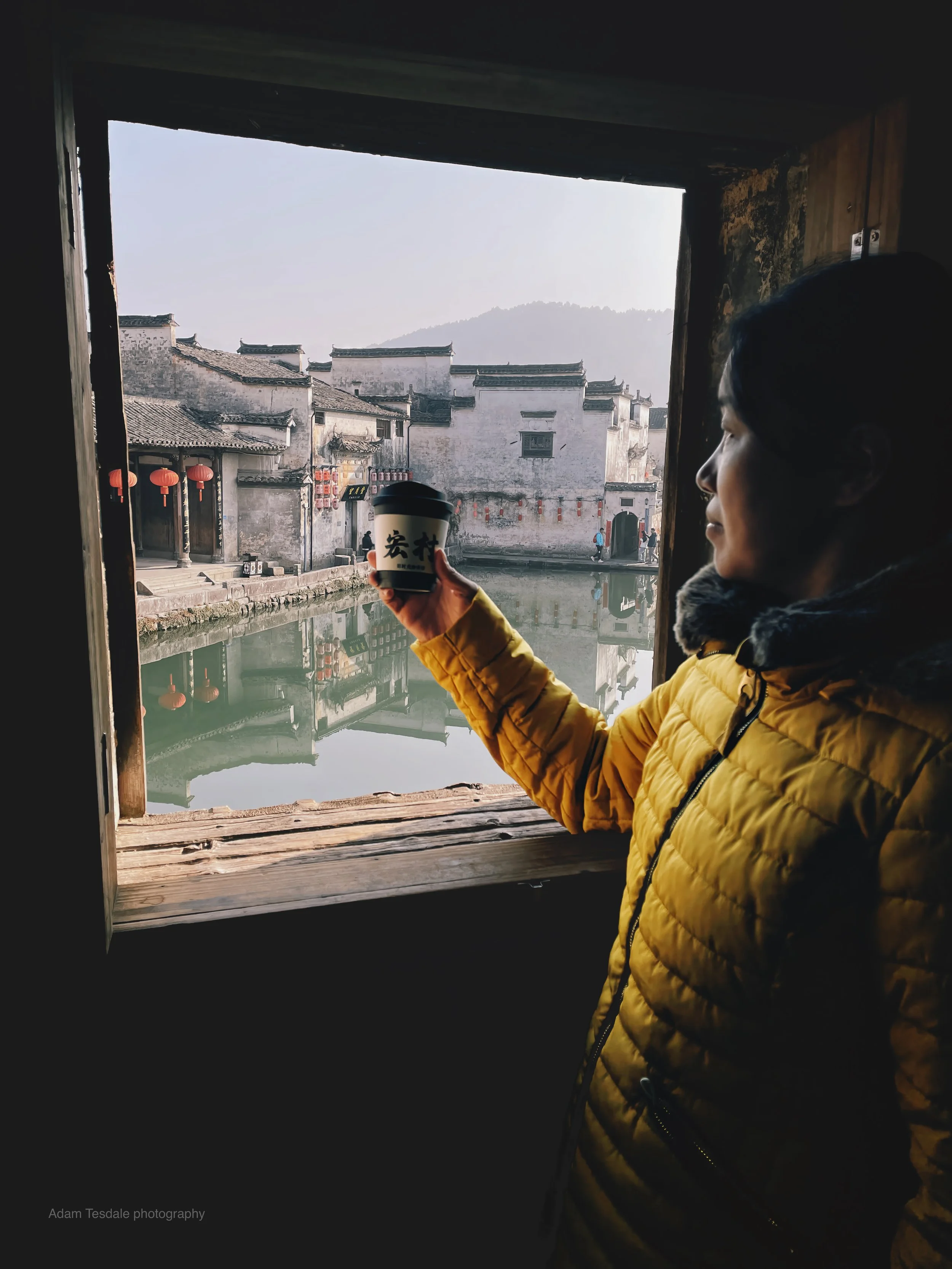
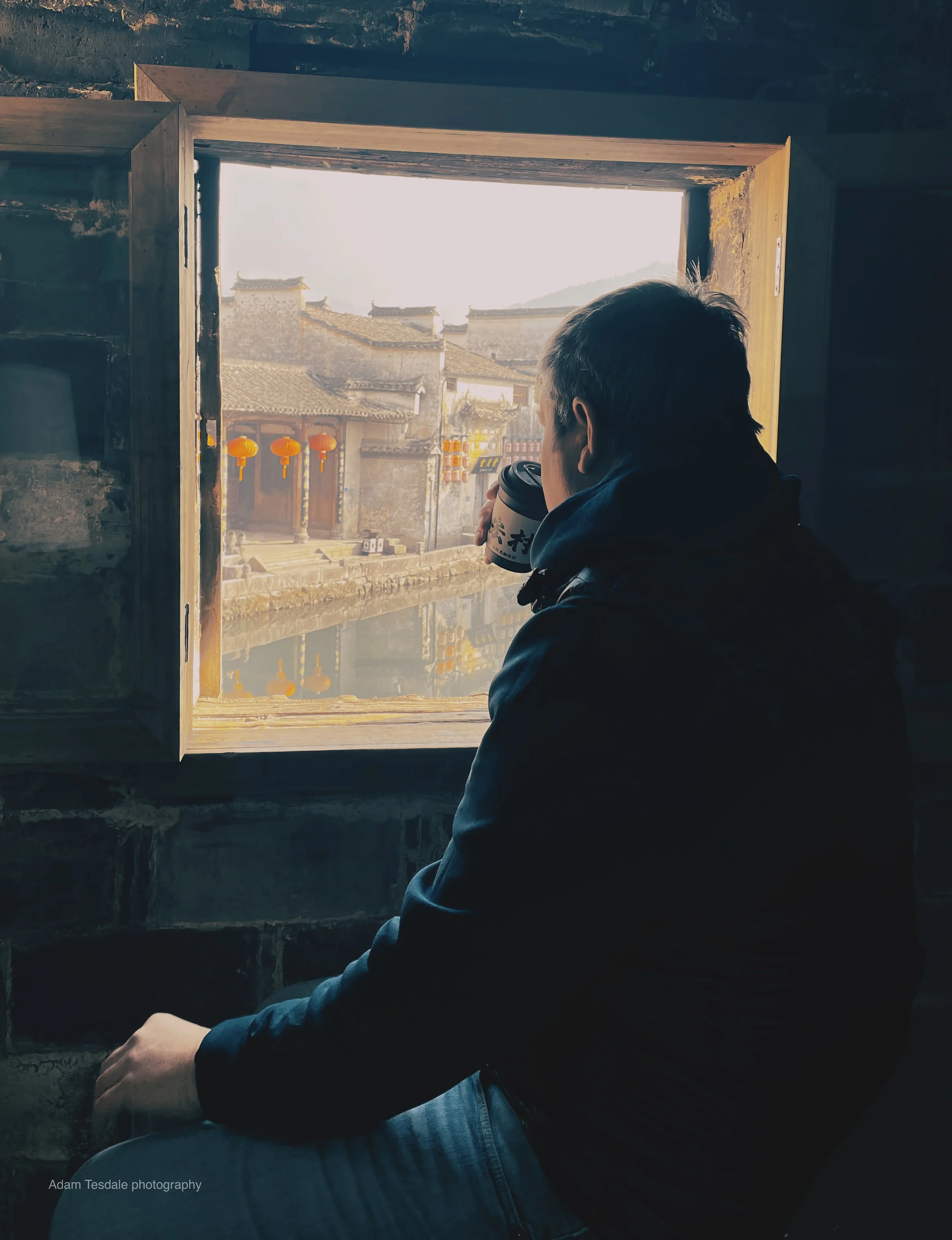
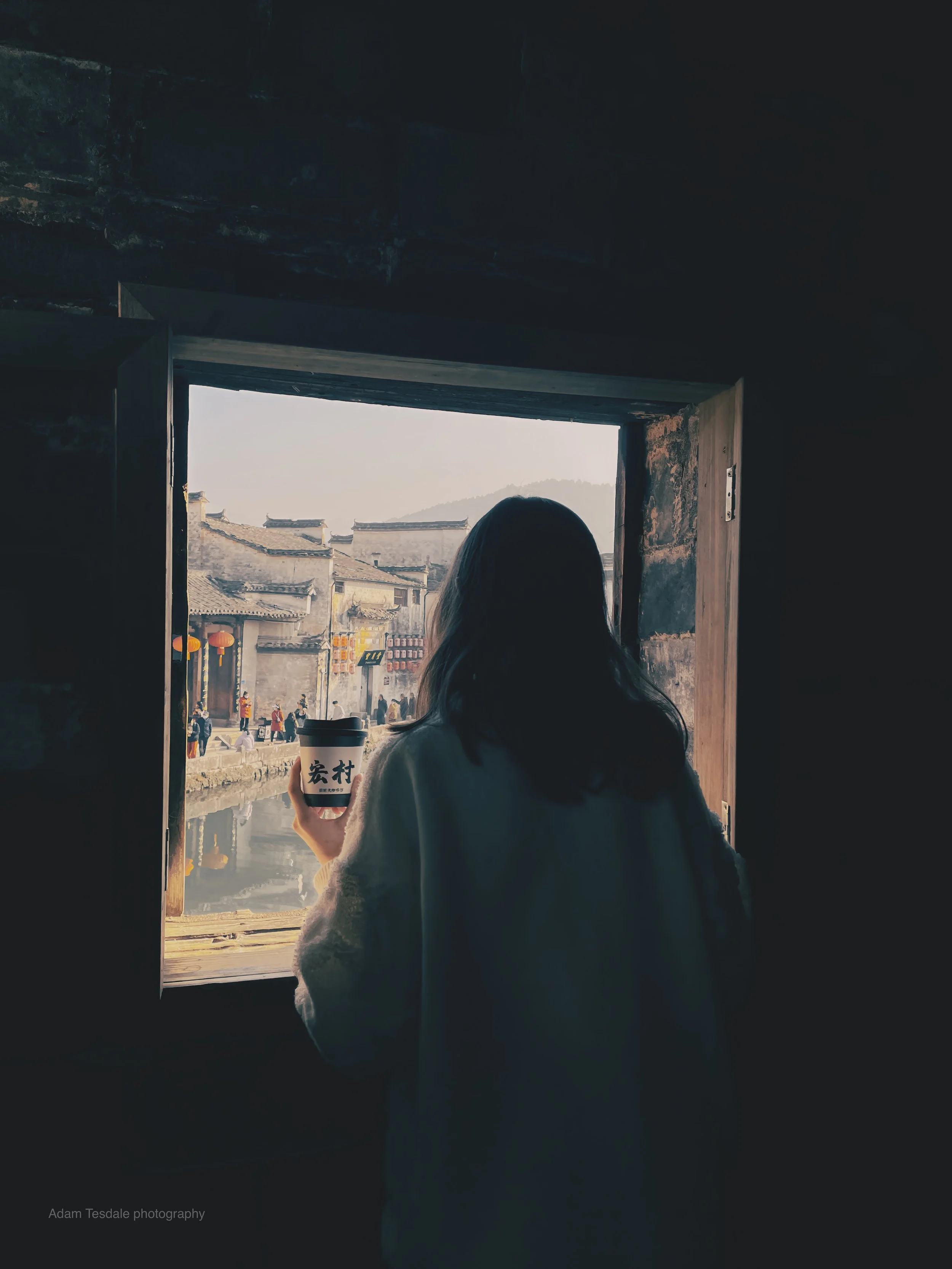
Hongcun has two famous coffee spots—the "net red" cafes that appear on every travel feed .
One is called "Half of Youlian" (半缕浮莲). It sits near the Moon Marsh, its classical wooden house structure drawing visitors inside. A large tank greets you at the entrance, marked with red characters advertising sour plum soup from a "century-old altar." The walls are covered with playful graffiti, kawaii characters that charm visitors of all ages .
By day, it serves coffee and Italian ice cream. By night, when the crowds have thinned and the lanterns glow, it becomes something quieter—a warm light in the ancient darkness.
The other sits elsewhere in the village, its devotees arguing passionately for its superiority. One reviewer abandoned "Half of Youlian" for this competitor, praising the coffee cup design—taller than standard, with a particularly interesting handle. The latte uses beans from Brazil, Colombia, and Yunnan—a blend as international as Hongcun's visitors .
Which is better? The debate continues among traveler’s. Perhaps the answer depends on whether you prefer your coffee with sour plum soup or with a view. Perhaps it depends on the light that day, or your mood, or simply which doorway calls to you first.

The Crescent Moon of Hongcun
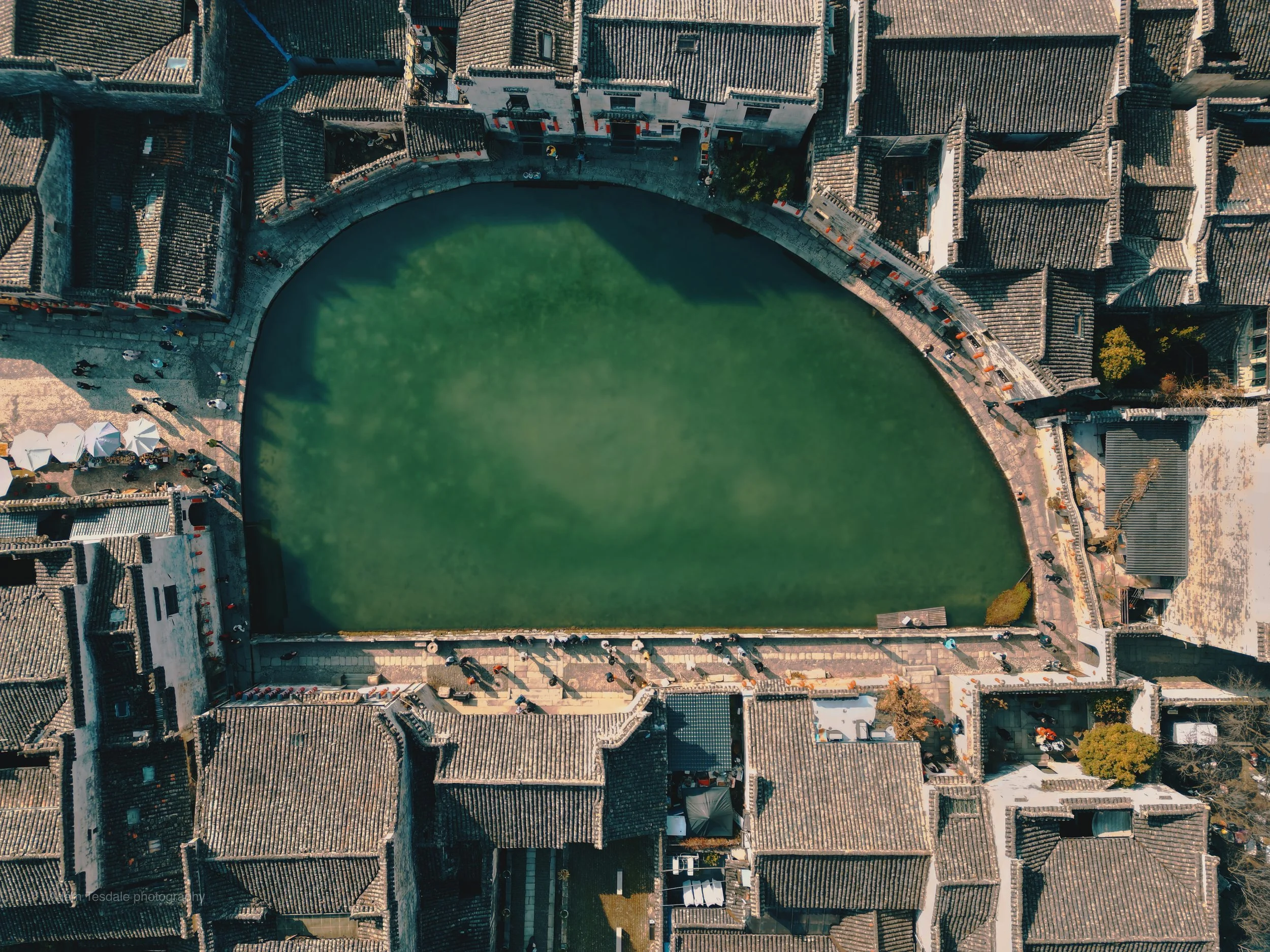
Seen from above, Hongcun becomes something unexpected: abstract art.
The grey-tiled roofs form a pixelated canvas of rectangles and squares, their edges softened by centuries of weather. The famous white walls, so dominant at street level, recede into narrow lines, defining the boundaries between public and private. Courtyards open like dark secrets among the grey. Trees rise in unexpected bursts of green.
And always, the water. The canals trace silver lines through the stone, following the ancient ox-shaped design that has carried mountain streams past every doorstep since the Ming Dynasty. They converge at the South Lake, where the village stops and the reflection begins—a perfect mirror that doubles the sky and anchors the entire composition.
From this height, the village is no longer a place you walk through. It is a pattern you read. A story written in stone and tile and water, waiting for someone high enough to see it whole.
Getting There: The Journey to the Painting.
Hongcun sits in southern Anhui province, approximately 60 kilometers from the city of Huangshan (the city, not to be confused with the mountain).
By Train:
The nearest high-speed rail station is Huangshan North. From there, you can catch a bus directly to Hongcun (about 90 minutes) or take a taxi (around 60-90 minutes depending on traffic).
By Air:
The closest airport is Huangshan Tunxi International Airport, with flights from major Chinese cities including Beijing, Shanghai, Guangzhou, and Chengdu. From the airport, a taxi to Hongcun takes about 90 minutes.
By Bus:
Regular buses run from the Huangshan Tourist Transport Center at the base of the Yellow Mountains directly to Hongcun. Many travelers combine a visit to Hongcun with a Huangshan hike—a perfect pairing of mountain and village.
Pro Tip: Hire a driver for the day if you're traveling with a small group. The flexibility to stop at lesser-known villages along the way (like the nearby Xidi, another UNESCO site) is well worth the cost.
When to Visit: The Light and the Seasons.
Hongcun rewards those who time their visit carefully.
Spring (March-May):
The village comes alive with new growth. Rape flowers bloom in the surrounding fields, adding splashes of yellow to the landscape. Mild temperatures and soft light make for beautiful photography, though crowds begin to build.
Autumn (September-November):
This is the photographer's season. The rice paddies turn gold, the air is crisp, and the villagers begin drying their harvest—chilies, persimmons, mushrooms on every available surface. The contrast of red and orange against the white walls is unforgettable.
Winter (December-February):
Cold and quiet. Mist hangs over the South Lake. Snow occasionally dusts the grey roofs. If you seek solitude and moody atmospheres, winter is your season.
Summer (June-August):
Hot, humid, and crowded. The reflections are beautiful, but so are the tour groups. If you visit in summer, arrive at the South Lake by 5:30 AM or resign yourself to sharing the view.
The Golden Rule: Visit on a weekday. Weekends bring domestic tourists from across China, and the narrow alleys can become impassable.
Where to Stay: Sleeping in History.
Hongcun offers something rare: the chance to sleep inside a UNESCO World Heritage site. Many of the old houses have been converted into guesthouses, offering simple but atmospheric accommodations.
Within the Village:
Staying inside the old town means you can experience Hongcun at its best dawn and dusk, when the day-trippers have left and the village returns to itself. Guesthouses are generally converted ancestral homes, with wooden beams, courtyard gardens, and modern bathrooms squeezed into ancient footprints. Expect thin walls, firm beds, and immense character.
Outside the Village:
Newer hotels and guesthouses line the road just outside the ticketed area. These offer more modern comforts and better value, but you'll need to re-enter the village each day.
My Recommendation: Splurge for one night inside the village. Wake at dawn. Walk to the South Lake before anyone else arrives. It is worth every yuan.
What to See: The Photographer's Map.
1. The South Lake (Nanhu)
The postcard view.
This is the image that launched a thousand travel dreams. The crescent-shaped lake sits at the village entrance, reflecting the old houses and the hills beyond. A stone bridge arches across one corner—the very bridge made famous by Crouching Tiger, Hidden Dragon.
Photography Tip: Arrive at least 30 minutes before sunrise. The water will be still, the light will be soft, and for one brief hour, you'll have the reflection to yourself.
2. The Moon Pond (Yueze)
The village heart.
Halfway through the village, the alleys open onto this perfect crescent of water. Surrounded by old houses and stone steps, the Moon Pond is where village life unfolds—women washing vegetables, children chasing ducks, old men playing chess in the shade.
Photography Tip: Shoot from ground level, including the stone steps in the foreground. The reflections here are even more intimate than the South Lake.
3. The Narrow Alleys
Where the village breathes.
Leave the main paths and get lost. The cobblestone streets narrow to shoulder width, the white walls rise on either side, and the water channels run alongside your feet. This is the real Hongcun.
Photography Tip: Look for shafts of light cutting through the alley in late afternoon. Include a figure in the distance for scale.
4. The Ancient Water System
Ingenious design.
Hongcun's canals were designed to mimic the digestive system of an ox—bringing mountain water past every doorstep. You'll cross small bridges and step over channels constantly. Follow the water; it knows the way.
5. Chenzhi Hall
Architectural masterpiece.
The largest and most ornate residence in Hongcun, built in 1855. The wood carvings are extraordinary—scenes from operas, mythology, and daily life, carved with breathtaking precision.
Photography Tip: Use a wide lens for the courtyards, a macro for the carvings.
6. The Surrounding Countryside
Beyond the walls.
Step outside the village gates and you'll find rice paddies, hills, and small farming communities. In autumn, the fields glow gold. In spring, they're brilliant green.
Eating and Drinking: Fuel for Wandering.
Local Specialties:
Stinky Mandarin Fish: An Anhui classic. Don't let the name deter you—it's fermented, not rotten, and surprisingly delicious.
Bamboo Shoots: Fresh from the mountains, often stir-fried with pork.
Tofu Varieties: Anhui does wonderful things with tofu. Try it smoked, fried, or stuffed.
Persimmons: In autumn, you'll find them drying everywhere. Sweet, dense, and intensely flavored.
Where to Eat:
Most restaurants cluster near the village entrances. Look for places filled with locals rather than tour groups. Point at what looks good if the menu confuses you. It usually works out.
Coffee Spots:
Two "net red" cafes compete for travelers' affection:
Half of Youlian (半缕浮莲): Near the Moon Marsh. Classical wooden house, playful graffiti, good coffee, and Italian ice cream.
The Other One: Devotees argue passionately for their favorite. Try both and decide for yourself.
Practical Tips for Travellers.
Entry Tickets:
You'll need to purchase a ticket to enter the village. It's valid for multiple entries over several days—hold onto it. Prices fluctuate, but expect to pay around 100-150 RMB.
Getting Around:
Hongcun is walkable. In fact, it's only walkable. Leave the wheels at the gate.
What to Pack:
Comfortable walking shoes. The cobblestones are beautiful and uneven.
A jacket, even in summer. Mornings by the water are cool.
Your camera. Obviously.
Cash. Some small shops and stalls don't take cards or mobile payments.
Respect:
Remember: this is a living village, not a museum. People live here. They raise children, cook dinner, and go to work. Be a respectful guest. Ask before photographing someone up close. Smile. Learn to say hello (nǐ hǎo) and thank you (xiè xiè).
Capturing Hongcun’s Soul: Photography Tips.
-
Early mornings (6–7 AM) are perfect for fog-kissed reflections on South Lake and Moon Pond, where villagers begin their day washing clothes or chatting by the water.
Late afternoons cast golden hues over the Hui-style rooftops. Climb Leigang Hill at sunset for a panoramic view of the village framed by autumn foliage or spring blossoms.
-
Use the mirror-like surfaces of South Lake and Moon Pond to create symmetrical compositions. A telephoto lens helps isolate details like lotus blooms or arched bridges
-
Highlight the weathered textures of ancient walls and carvings. The Chengzhi Hall, adorned with gilded wood carvings, becomes even more dramatic in monochrome.
-
Visit Tachuan Village (30-minute walk from Hongcun) in late October–November. Its fiery maple and ginkgo trees, ranked among China’s "Four Greatest Autumn Sceneries," are a burst of color.
Yellow coat.
Beyond Hongcun: The Anhui Circuit.
Hongcun sits in a region rich with wonders. Consider extending your trip:
Xidi: Hongcun's UNESCO sister village, less watery but equally beautiful. About 20 minutes away.
Huangshan (Yellow Mountain): One of China's most famous peaks. The granite spires, ancient pines, and sea of clouds are justifiably legendary. Plan at least two days.
Tunxi Old Street: In Huangshan city, a charming historic street with shops, teahouses, and museums. Good for a half-day before catching your train.
Chengkan: A lesser-known village with a fascinating layout based on the Bagua (eight trigrams). Fewer crowds, more mystery.
Final Thoughts: The Painting Waits.
Hongcun has survived nine centuries by adapting while remaining true to its character. The water still flows through the ancient canals, reflecting tiled roofs and willow branches. The houses still face the Moon Pond, their eaves casting familiar shadows on the stone. The villagers still dry their chilies in the autumn sun, keeping alive routines passed down through generations.
But now, there is coffee where once there was only tea. There are travelers from around the world where before there were only farmers and merchants. There is even an Austrian teaching English in a Ming Dynasty building. The painting has shifted its colors and subjects. But it remains a painting. And it remains beautiful. Come see for yourself. Stroll the narrow alleys. Watch the sunrise double itself in the South Lake. Sit by the Moon Pond with a coffee and quietly watch the village live and breathe. Hongcun is waiting.
