Nantong
From the Cotswolds to the Unknown: My Leap of Faith into China
Back in the year 2000, I found myself at a classic crossroads. I had just finished my four-year degree in Sport and Exercise Science at the University College Worcester. The only catch? I was a 25-year-old mature student, still living at home with my parents.
With a fresh degree in one hand and a student loan in the other, I was finally ready to enter the rat race. But the thought of a standard 9-to-5 didn't quite fit. I had a few quid in the bank and a thirst for something different, so I started searching for opportunities overseas.
The search began in my dad’s study, on his old desktop computer. I can still hear the painful screech of the dial-up modem connecting. The internet was painfully slow, but my mission was clear. Every single search began with the same phrase: teach in China.
I stumbled across a recruitment agency (the name is long forgotten) and signed up on a whim, thinking little of it. A few days later, an email arrived asking for documents just my passport and degree certificate. That was it. No interviews, no fuss. A few days after that, I got the news: I was successful. I would be teaching in a place called Wuxi.
I had absolutely no idea where that was.
My parents, like many Brits at the time, had a very limited knowledge of China. To them, it was a place where everything was made and, as they vaguely recalled, somewhere with tanks. To say they were nervous would be an understatement especially as their son did not speak a word of Mandarin.
The next few days were a blur. I was leaving in a week. I sold most of my prized possessions, including my beloved kayak, all my caving gear and gave my Vaxuhall Cavalier to. my dad. I packed my life into a single rucksack. Then, all too soon, my parents dropped me off at Gatwick Airport.
Naturally, my bag was overweight. But in a twist of fate, the kind lady at the check-in desk smiled and upgraded me to business class. It was the first and only time that has ever happened to me!
I settled into my luxurious seat on the top deck, feeling like a fraud, ready for my first stop: Beijing. From there, I was scheduled to catch a connecting flight to Wuxi.
Or so I thought.
The Mr. Adam Sign and a City on Fire: Arriving in Nantong
The business class champagne was a distant memory as I stumbled off the plane in Beijing, my rucksack feeling heavier than ever. Scanning the crowd of drivers holding signs, I spotted it: a neatly printed card reading "Mr Adam," held by a smartly dressed Chinese gentleman. His name was Mr. Xia, and his English was excellent. He was, as I would later learn, the Head of Nantong TV station and the husband of the principle of Nantong Foreign Language school.
There had been a slight change of plan. I wasn't going to Wuxi after all. I was going to Nantong to teach at Nantong Foreign Language school.
Of course, the name meant nothing to me. This was 2001. I couldn't just whip out a smartphone and google it. My trusty Nokia 3110 was good for one thing: making calls and playing games. So, I simply nodded, boarded another plane, and put my trust in this smartly dressed man with the sign.
I remember that day as if it were yesterday. It was March, and the air was thick with the haze of burning crops. As the small plane descended towards a single, lonely runway, I could see the flicker of field fires dotting the landscape below. We landed with a bump, and I peered out the window, looking for the sprawling, futuristic airport terminal I had imagined. In my head I was looking for Heathrow but it was Xingdong Airport on the outskirts of Nantong.
Instead, I found a tiny, single-building airstrip.
There were no air bridges or shuttle buses. We simply walked across the tarmac. Our luggage was piled onto a cart and brought to the entrance. As I grabbed my bag, I looked up to see a small, lovely crowd of people holding up another "Mr Adam" sign, frantically waving at me.
In the group was Jane (her English name), Mr. Zha, and Mr. Lee, who would become my Foreign Experts Liaison. They greeted me with such warmth that my anxiety the confusion of the last few hours instantly melted away.
They led me to the "school bus" driven by drive Gao, a vehicle that would become a familiar sight and we began the 40-minute drive into the city. I pressed my face to the window, utterly in awe. The roads were a chaotic, beautiful symphony of movement. Bikes mingled with odd, three-wheeled tractors, lumbering buses, and sleek Santanas, which I soon learned were the most common car on the road. It was a world away from the quiet streets of the Cotswolds.
I had left England expecting to land in one place, but fate, and a kind gentleman with a sign, had brought me somewhere else entirely.
Two Worlds Apart: Chipping Sodbury and the Rise of Nantong
To truly understand the leap I had taken, you have to picture where I came from. Chipping Sodbury, nestled in the Cotswolds, was and still is the epitome of an English market town. Think honey-coloured stone, a high street with centuries of history, and a pace of life dictated by the seasons, not the stock market. It was quiet, safe, and deeply traditional.
At the turn of the millennium, China was in the midst of a breathtaking transformation. The economic reforms of the previous two decades were hitting their stride . It was a nation shaking off its past and charging towards the future. State owned enterprises were being reshaped by market forces, and the old certainties of lifetime employment were giving way to something more dynamic and uncertain. For ordinary people, this meant their livelihoods were changing fast.
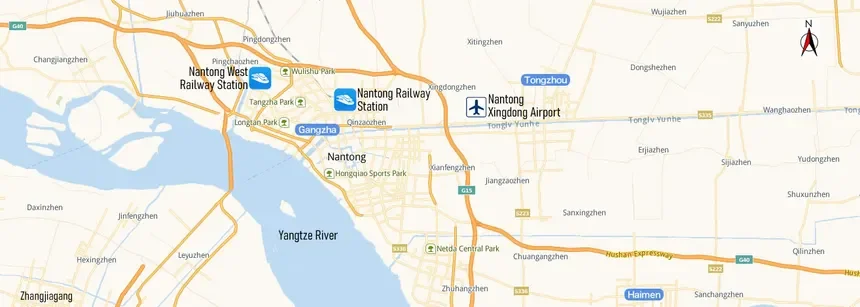
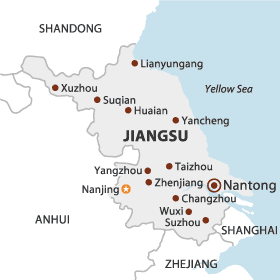
Nantong, a prefecture-level city in Jiangsu province, was a perfect snapshot of this new China. It was, and is, a "medium sized city" nestled on the northern bank of the Yangtze River, directly opposite Shanghai. While the official figures from the Nantong Statistical Yearbook 2000 would paint a precise picture of its 8.5 million residents, my own eyes told a different story.
From the window of that school bus, I wasn't seeing statistics. I was seeing a city in a hurry. The academic papers would later describe the 1990s and 2000s as a period of accelerated urban growth, with new towns and county seats sprouting up everywhere. I was seeing it firsthand. The roads were a chaotic mix of the old and the new—the three-wheeled tractors and bikes of a bygone era sharing tarmac with the Santanas, BMWs and Porsches that symbolized China's new consumerism.
Where Chipping Sodbury was static and ancient, Nantong felt temporary and new. It was a city being built, literally, before my eyes. The smoke from the burning fields wasn't just a seasonal clean-up; it felt like a symbol of the old being cleared to make way for the relentless march of the new. I had swapped the gentle hills of the Cotswolds for the flat, energetic sprawl of the Yangtze Delta, and my life would never be the same.
Silk, Steel, Soap and Ships: The Fabric of Daily Life
If Chipping Sodbury's heartbeat was the weekly market and the parish church, Nantong's was the rhythmic clatter of textile looms and the deep rumble of industry. In 2000, this was a city built on making things.
The local economy was a powerhouse of manufacturing. Textiles and garment manufacturing were king. This wasn't small-scale craft; it was serious industry. Companies like Jiangsu Di'ao Group were producing hundreds of thousands of garments, their "Di'ao" brand becoming a recognized name across the province. Joint ventures with Japanese and American partners were springing up, churning out everything from casual jackets to high-end ladies' fashion for both domestic and international markets. You couldn't walk far without passing a factory or a workshop, the hum of sewing machines a constant backdrop to city life.
Alongside the textiles, a strong mechanical and metallurgical sector formed the city's industrial backbone. This wasn't just about heavy machinery; it was the precision engineering that supplied parts for the nation's rapid industrialisation everything from agricultural machinery to oil pumps and cables. It was the kind of gritty, essential work that paid the bills for thousands of families.
And then, there was the soap. Nantong was famous for it. I can still picture the chunky, amber bars of Nantong Soap a local institution. You'd find it in every household, every hotel, every tiny corner shop. It had a distinctive, clean scent that, for me, would forever become the smell of China. It wasn't fancy, but it was dependable, and it was undeniably Nantong. It was a small but telling detail: this city didn't just make clothes and machinery; it made the everyday essentials that went into every home.
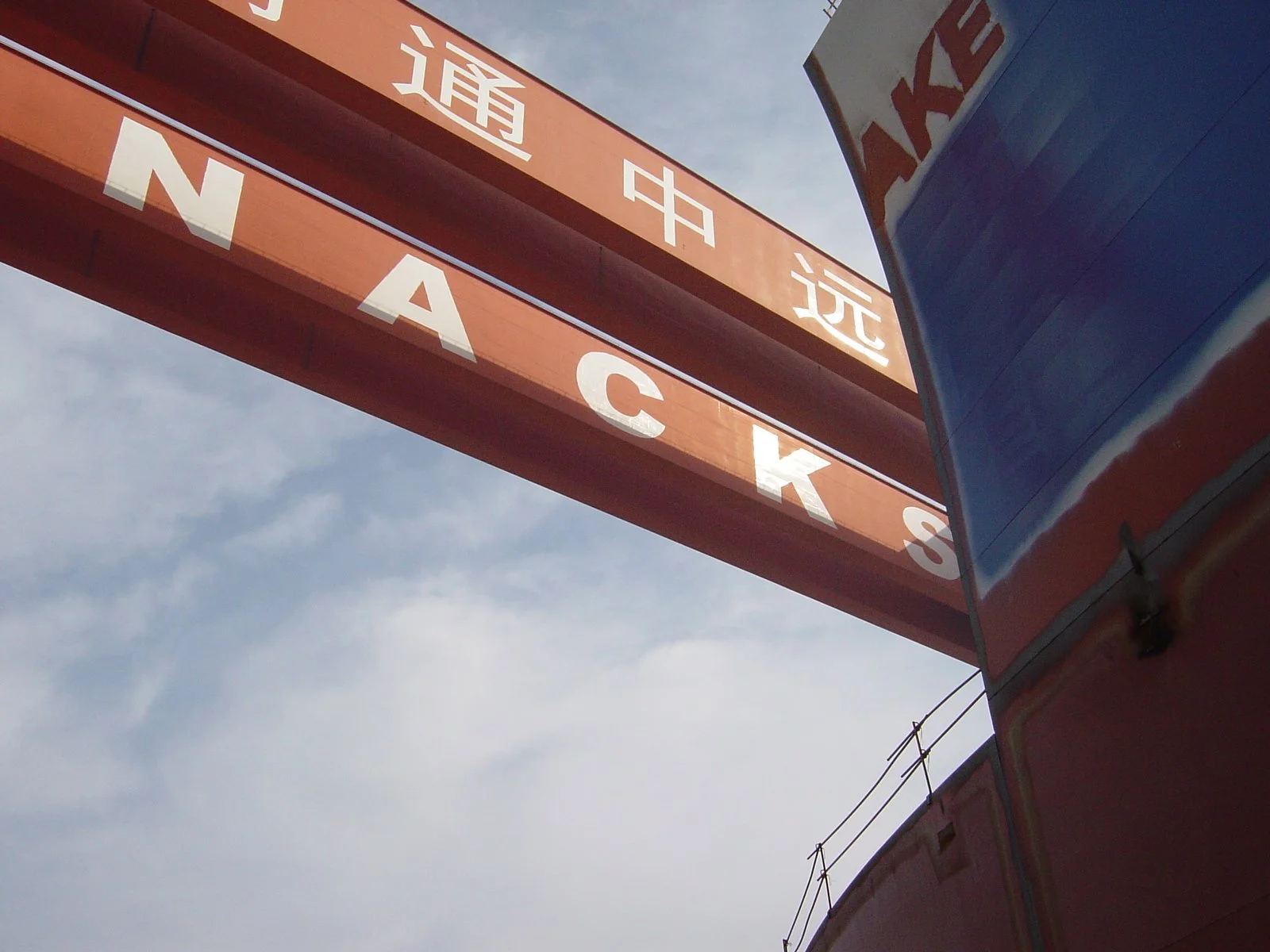
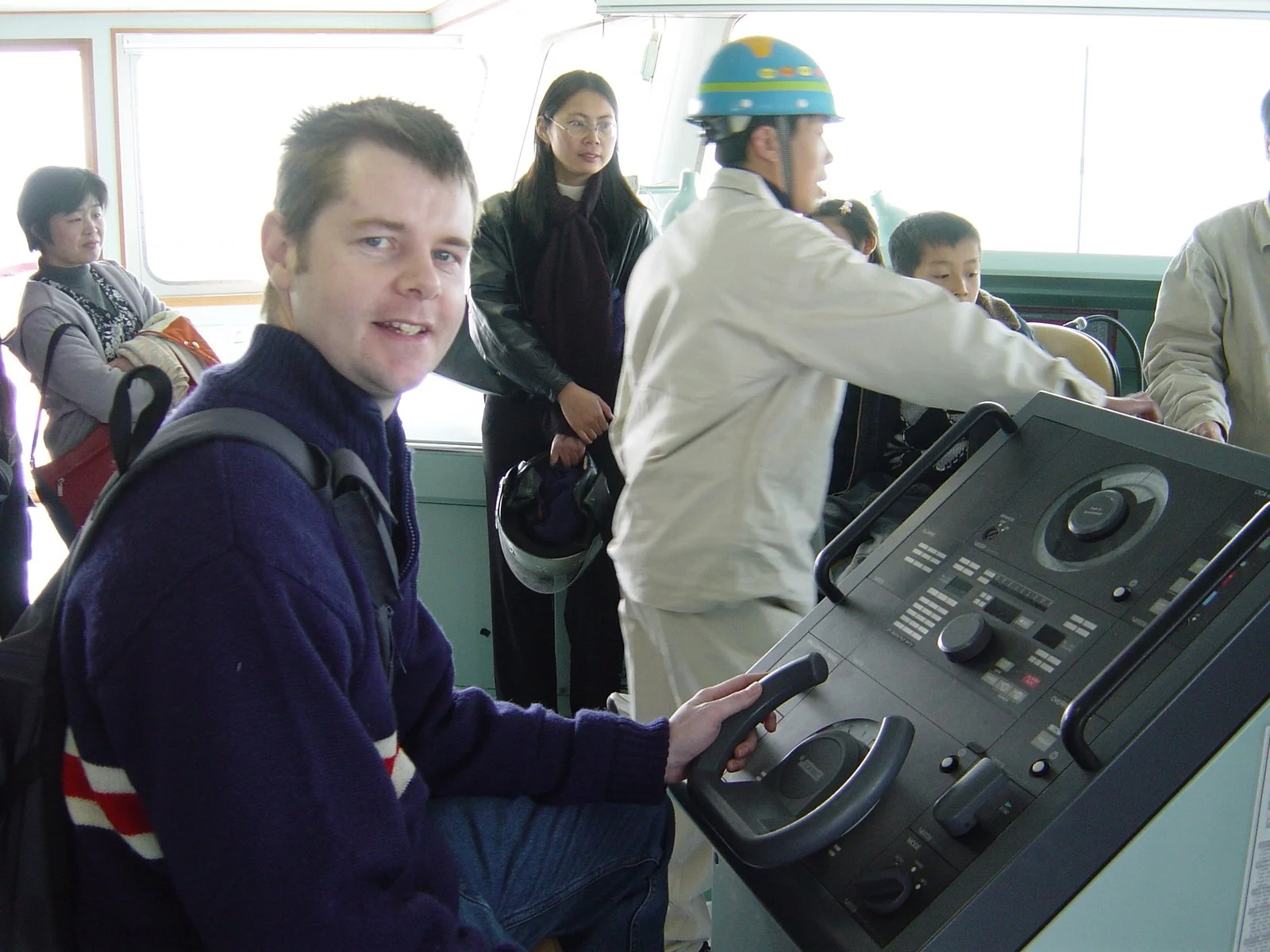
But perhaps the most imposing presence on the city's industrial landscape sat right on the banks of the Yangtze River. COSCO the China Ocean Shipping Company had a major footprint in Nantong. The Nantong COSCO KHI Ship Engineering Co. or NACKS, had been established back in 1995 as a joint venture with Japan's Kawasaki Heavy Industries. It was China's first large scale Sino-foreign shipbuilding enterprise, and by the time I arrived, it was already a behemoth. Months later I would find myself on the deck of one of the worlds largest container ships and doing the voice over for a company ad.
Driving past the shipyard, you'd catch glimpses of massive hulls towering above the dock walls bulk carriers, tankers, and container ships destined for oceans I'd only ever dreamed of crossing. The scale of it was mind-boggling. These weren't just boats; they were floating cities, and they were being built right there in my new hometown. It gave Nantong a tangible connection to the wider world, a world that suddenly felt a little smaller.
So, what did all this work pay? In 2000, the average annual wage for a worker in an urban non-private enterprise in Nantong was just over 11,600 yuan. To put that in perspective, across the wider city region, the average was a bit lower, around 9,200 yuan a year. That works out to somewhere between 770 and 970 yuan per month. In British pounds at the time, that was roughly £60-£75 a month. A fraction of what I would have earned back home.
Life on that wage was simple and focused. A meal at a local noodle or dumpling shop cost a couple of yuan. A new outfit from one of those very factories might be a significant purchase. Most families lived in modest apartments provided by their work units, their prized possessions often being the new television or the bicycle they used to navigate the bustling streets. Savings were pooled together for big life events: a wedding, a child's education, or perhaps the dream of one day owning one of those ubiquitous Santana cars I saw everywhere. And when they washed that Santana on a Sunday morning, chances are they reached for a bar of Nantong soap.
And amidst this industrial hum, there was history. In fact, 2000 was a significant year for Nantong's built heritage (I recently made a vlog about this.) The city decided to restore the ancient Watchtower. First built in 1180, it had stood for centuries as a city gate, slowly falling into disrepair. That very year, as I was arriving as a fresh-faced teacher, local workers were busy restoring it to its original appearance. Standing right in front of it was the very different, 22.6-meter-high Bell Tower, built in 1914 by the famous local industrialist Zhang Jian. With its English-influenced style, it was a curious echo of my own homeland, standing as a proud monument to Nantong's past, even as the city raced headlong into its industrial future.
Lions, Steel Doors, and a Feast of Frogs' Legs: My First Night
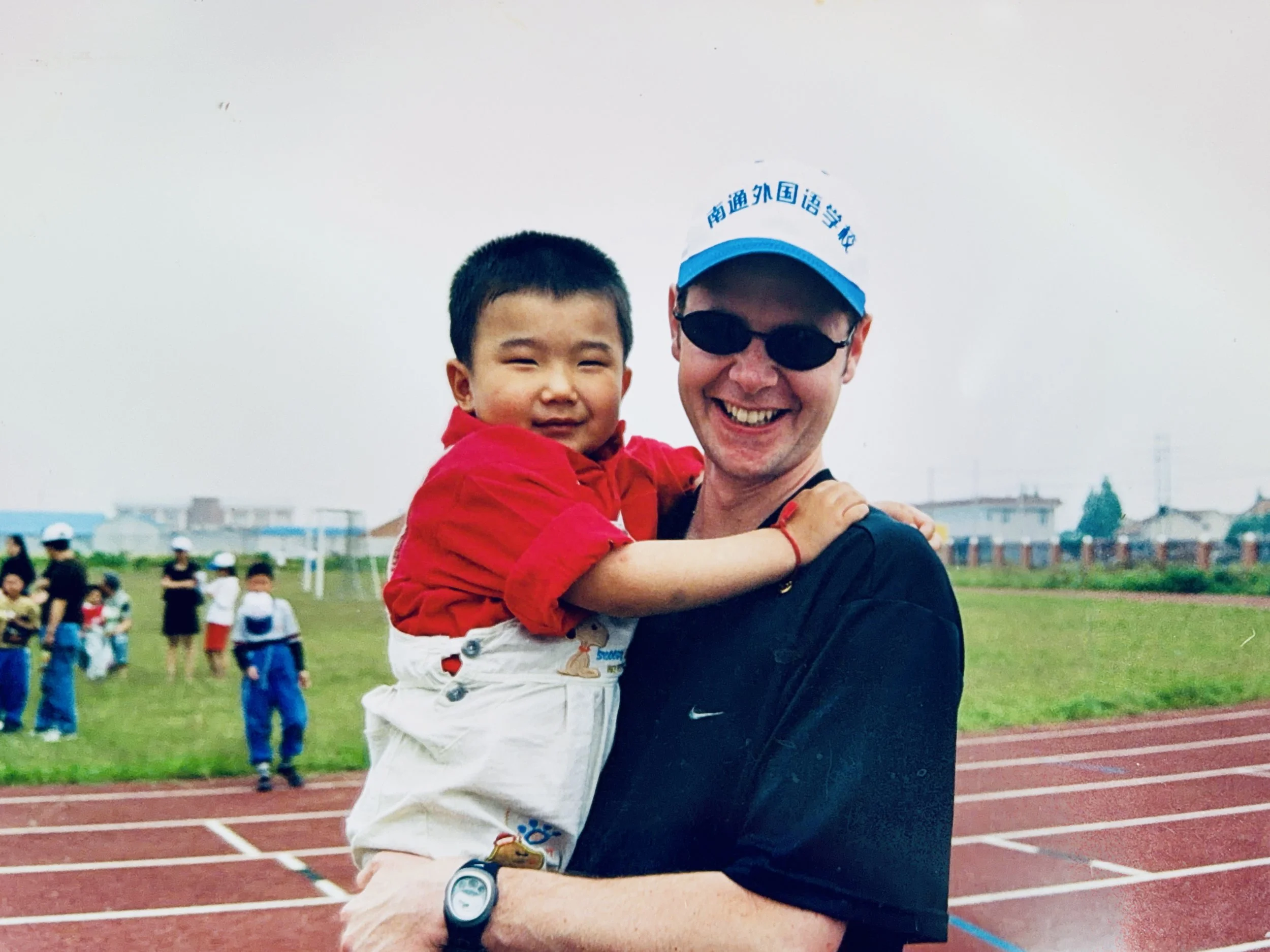
After what felt like an eternity navigating the glorious chaos of Nantong's traffic, Gao, our driver, finally pulled up to an impressive gatehouse. Flanking the entrance were two enormous stone lions, carved with such fierce detail they looked ready to pounce. Beyond them lay a modern school campus, a collection of sleek buildings sprawled out before me. And to the right, almost like a sign from the universe given my Sports Science background, sat a proper athletic track.
Before I could take it all in, I was whisked away to my accommodation at the back of the main building, right next to the boarding houses for the primary and senior pupils. My new home was behind a heavy steel door—a detail that felt both secure and slightly ominous.
I stepped inside.
The room was simply furnished. A double bed. A desk with a bulky desktop computer. A small kitchen area with a sink and a microwave. A sofa and a small eating table. It was sparse, but it was mine. I barely had time to drop my rucksack before I was ushered back out the door. No rest for the weary. I was being taken for my first Chinese supper.
We arrived at one of the top restaurants in Nantong. I later learned the owner also ran the only Western bar in town, the legendary "Captains Bar," which I'm delighted to hear is still going strong today, albeit in a different location.
As we were led to a private room, my mind drifted to comforting thoughts. This is it, I thought. Chicken chop suey. Sweet and sour pork. Egg fried rice. The usual suspects from the takeaway back home.
This was not that.
This was China. A vast banquet table groaned under the weight of dishes I couldn't have imagined. There were frogs' legs, turtle, an array of whole fish, platters of shrimp, and piles of crab. I watched, slightly horrified, as my companions dug in with gusto. For someone who doesn't eat shellfish, it was a challenging start. Thankfully, I spotted some familiar-looking meat dishes, tofu, and a few vegetable plates I could safely swallow.
And then came the toasting.
A tiny glass was placed before me and filled with a clear liquid that smelled like paint thinner mixed with nail polish remover. This was Moutai—China's famous sorghum liquor. The Chinese affectionately call it "baijiu," but I mentally renamed it "rocket fuel" on the spot. It was certainly a drink that warmed the cockles of your heart, mostly because it felt like your chest was on fire. It was the beginning of a long and complicated love-hate relationship.
So there I sat, surrounded by people whose names I was still learning, desperately trying to manipulate a pair of chopsticks with all the grace of a newborn giraffe. Every failed attempt to grip a slippery piece of tofu was met with peals of laughter from my new friends. They clapped me on the back, refilled my glass, and showed me, again and again, how to do it properly.
I was exhausted, overwhelmed, and probably mildly poisoned by Moutai. But as I looked around that table, at the smiling faces and the endless parade of strange and wonderful food, I realised something profound.
I wasn't in the Cotswolds anymore. And somehow, despite the steel doors and the culinary curveballs, that felt exactly right.

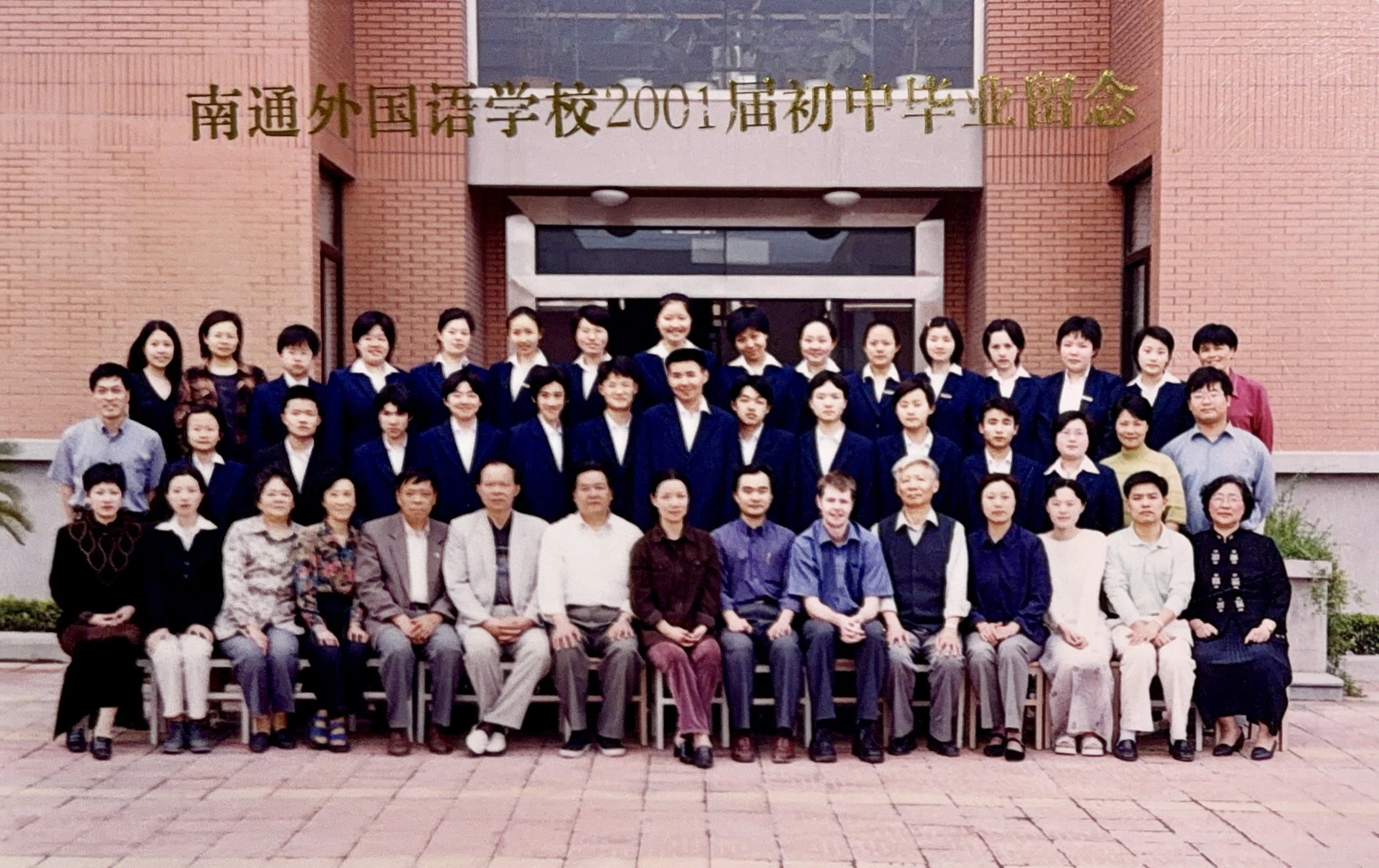
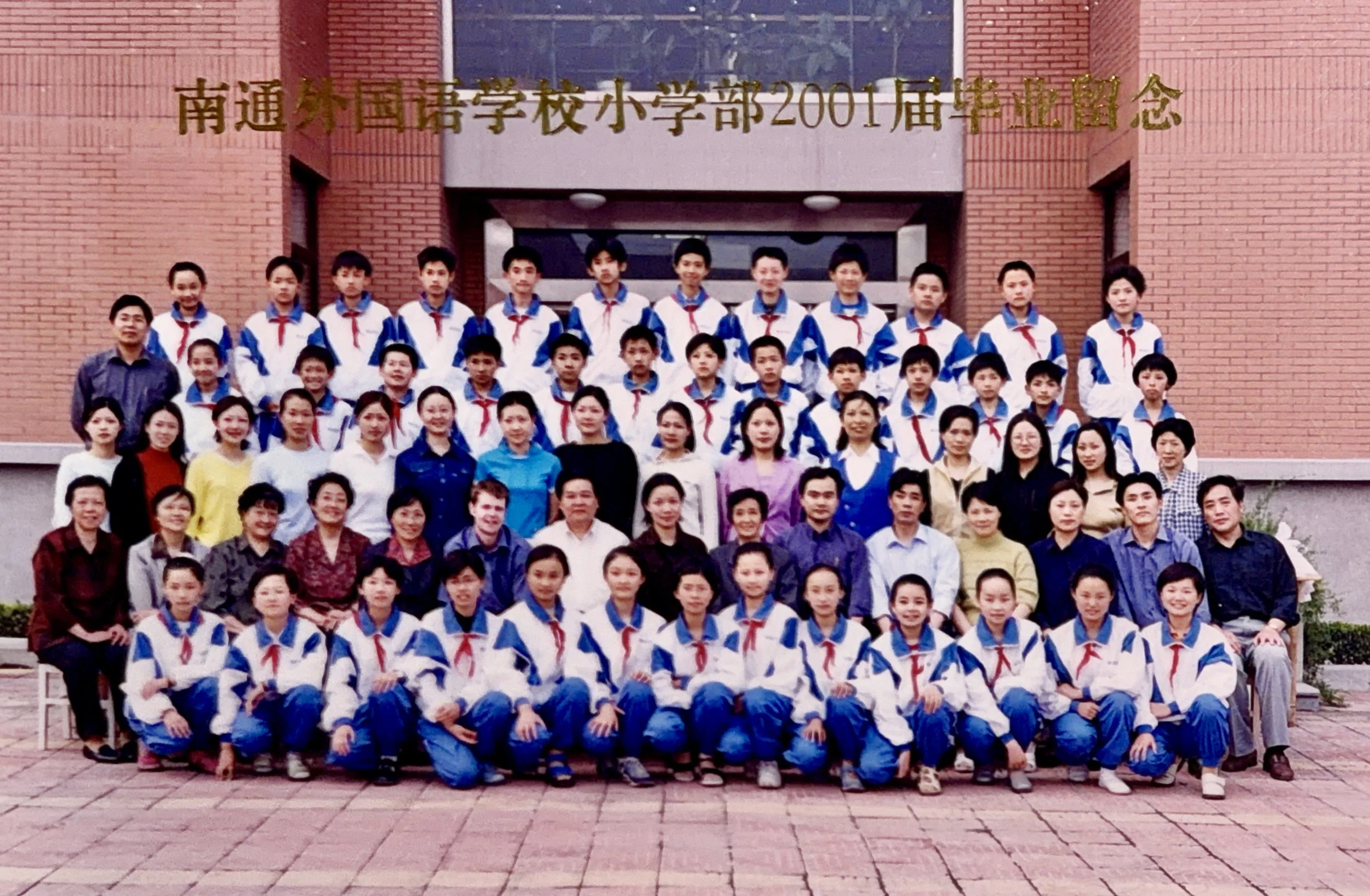
Red Flags, Rice, and Rigorous Routines: Life at Nantong Foreign Language School
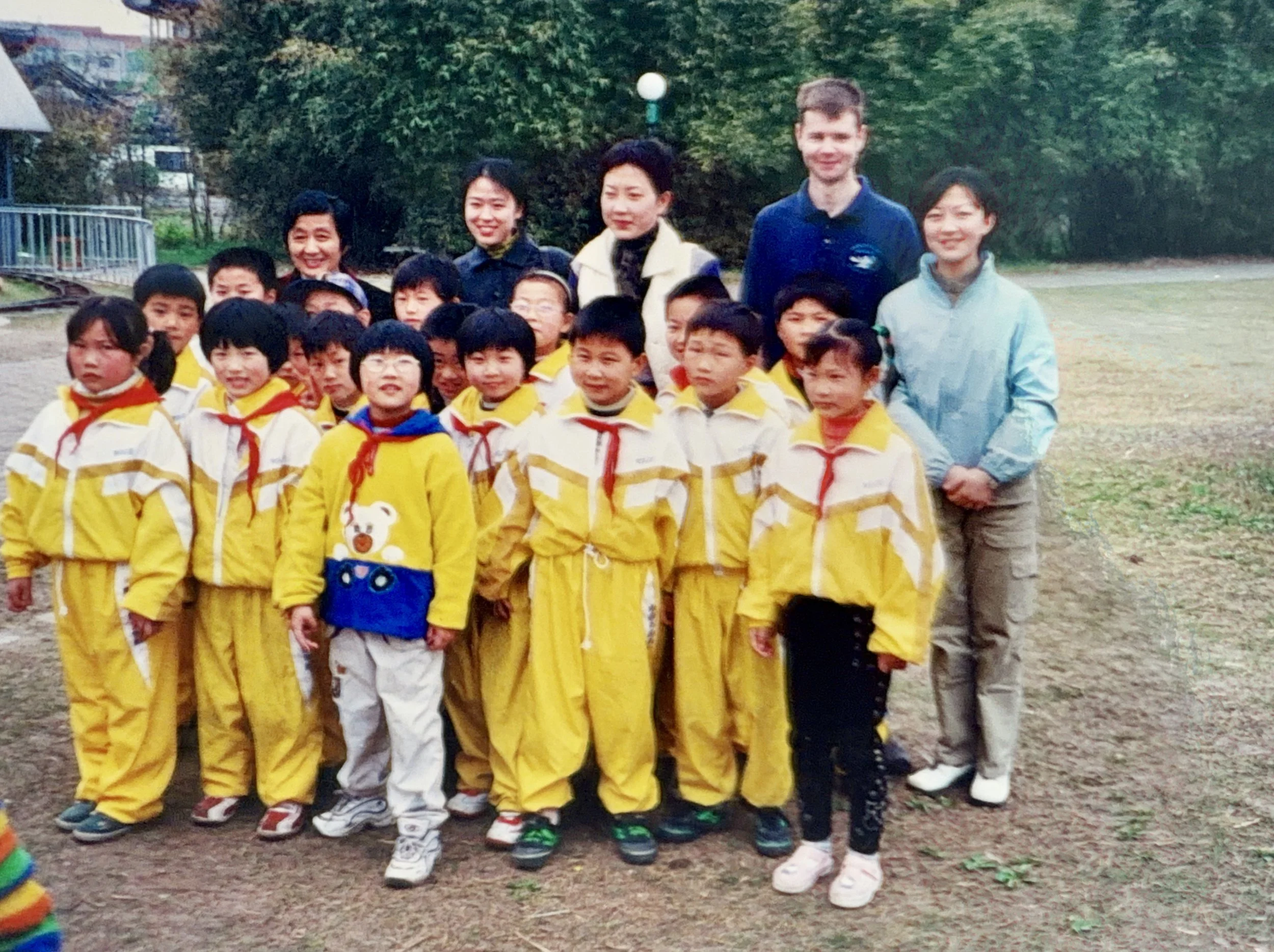
The steel door became my portal to a new world each morning. I was teaching at a private school, Nantong Foreign Language School, and it operated at a pace I'd never encountered before. Students from the ages of seven to eighteen flooded the corridors, a sea of youthful energy wrapped in matching uniforms with their bright red neckerchief.
Some were day boarders, and I genuinely grew to love hopping on the bus with them each afternoon, watching the city roll by as we dropped them off at their homes. Others stayed all week, heading back to their families only on weekends. The school was their universe, and for the next year, it would be mine too.
Each classroom followed the same blueprint. Desks were arranged in neat, disciplined rows, a far cry from the chaotic group work I remembered from British schools. Textbooks were either tucked away in individual desk drawers or stacked in tidy piles on the floor. At the front stood the teacher's domain: a sturdy desk and the iconic green chalkboard. And standing guard over it all was the class monitor, a role taken with deadly seriousness. Their job was to keep the room spotless and, most importantly, to clean the chalkboard before each lesson. It was a small duty, but it instilled a sense of responsibility I found admirable.
The students' day began at an hour I tried very hard to forget. 6:30 AM. They would stumble out of their dormitories and onto the athletic field for morning exercise, a school-wide ritual designed to wake the body and sharpen the mind. A bit bleary-eyed I would join the pupils for this daily ritual.
Breakfast in the cavernous canteen was a simple, hearty affair. They'd queue up for bowls of warm porridge, hard-boiled eggs, mounds of steamed bread, or steaming noodles, all washed down with cups of sweetened soya milk. It was fuel for the long day of study ahead.
Lessons ran in 45-minute blocks. At 11:30 AM, the lunch bell rang, and the entire school decamped to the canteen again. Then came a surprise: nap time. Yes, nap time. After lunch, the entire school would fall silent. Students would retreat to their dorms, and I'll admit, I often took advantage of this blessed pause to stumble back to my room for a quick snooze myself. It was civilized. It was necessary. It was brilliant. It was hard to get up!
Lessons resumed in the afternoon, but the start time shifted with the seasons. In winter, we'd begin again at 1:30 PM. But in the brutal heat of a Nantong summer, when the classrooms became furnaces, we'd delay until 2:00 PM, giving the worst of the heat a chance to pass.
The final bell rang around 5:00 PM. Supper followed, and then came evening prep. For the senior students, this was no gentle homework hour. They would study in supervised sessions until 10:00 PM. And even then, I'd often see lights flickering in the dormitory windows late into the night, as the most dedicated or most desperate continued to pore over their textbooks by torchlight. The pressure was immense, and it was humbling to witness.
And then there was Monday. Every single Monday, without fail, the entire school would assemble on the field for the flag-raising ceremony. I'd stand at the back, watching hundreds of young faces turn towards the red flag as it was slowly raised on the pole. The national anthem would crackle over the loudspeakers, and for those few minutes, the chaos of the school day paused. It was a ritual, a moment of unity, and a reminder that I was a very long way from the Cotswolds.

Crayfish, Contraband, and Crossing the Fence: My Life as a Teacher
My first day at Nantong Foreign Language School began in the principal's office. And not just any office Ms. Chen Ke Ping presided over a room that felt as vast and important as she was. Her English was impeccable, polished to a gleam by years of study and practice overseas. We talked for a long time, her questions about England and my journey met with equal curiosity about the school I was about to call home.
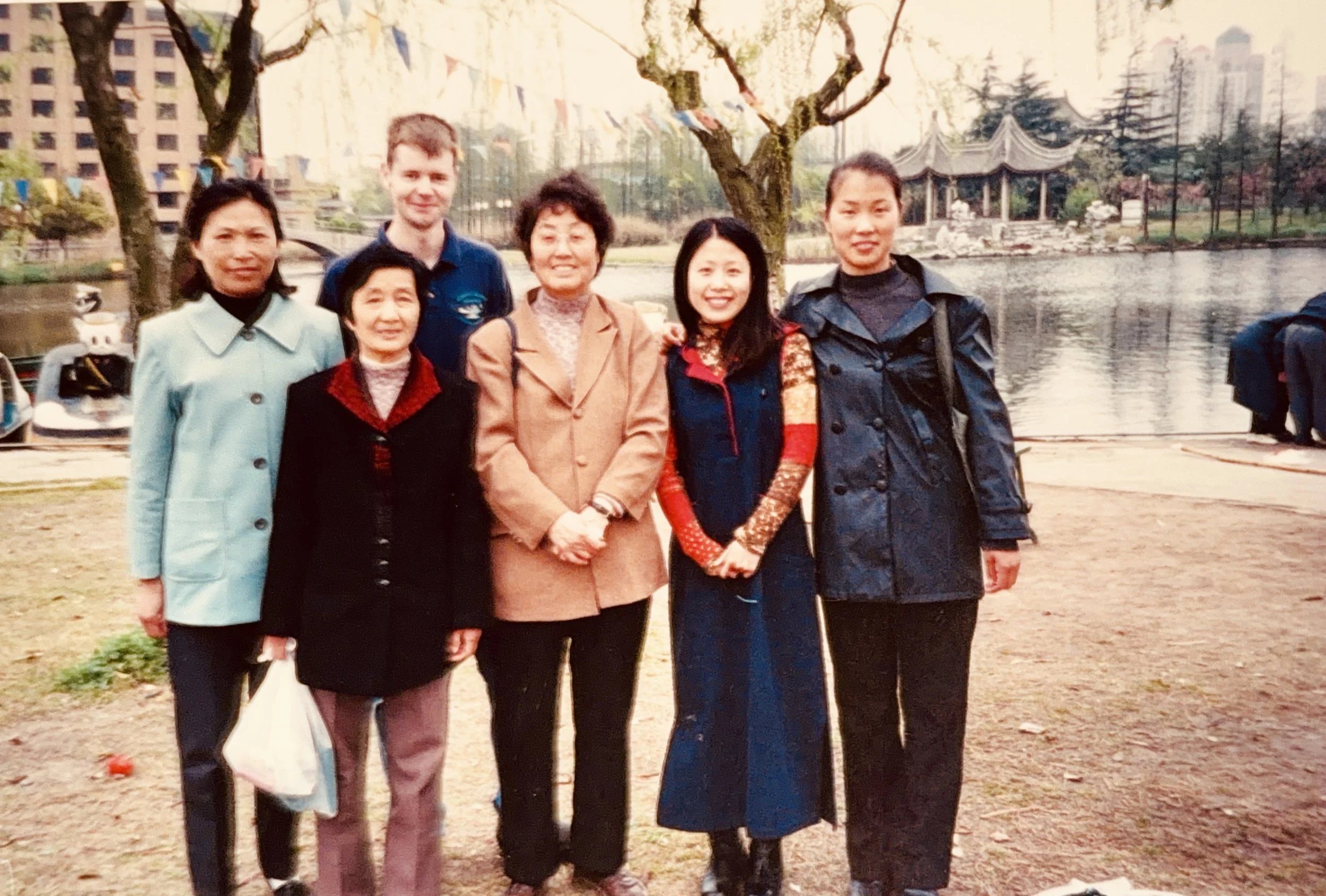
After our meeting, Mr. Zha and Mr. Xia took over, escorting me through the sprawling campus like proud parents showing off a new baby. We wandered through buildings, across courtyards, and into staff rooms where teachers would stop what they were doing to greet me with warm smiles and hesitant English hellos. It was overwhelming, in the best possible way.
Finally, we arrived at the English office. Jane was waiting, and she introduced me to the Chinese English teachers I'd be working alongside. They were a mix of seasoned professionals and bright eyed recent graduates, all united by a common mission: to teach these kids a language that must have felt impossibly foreign.
My role was simple on paper: teach English to the primary pupils. In practice, it was chaos, joy, frustration, and hilarity in equal measure. I worked roughly 20 hours a week, a schedule that felt almost decadent. And my salary? 3,500 RMB a month. About 350 pounds. Back home, that would have been pocket change. But in Nantong in 2000, it was enough. More than enough. I lived the best life.
The students were everything. They were inquisitive, crowding around me during breaks to ask questions about England, about my family, about whether I missed my mum. Some were painfully shy, hiding behind their textbooks and peeking out when they thought I wasn't looking. Others had no such inhibitions, launching into broken English conversations with a confidence that made me grin.
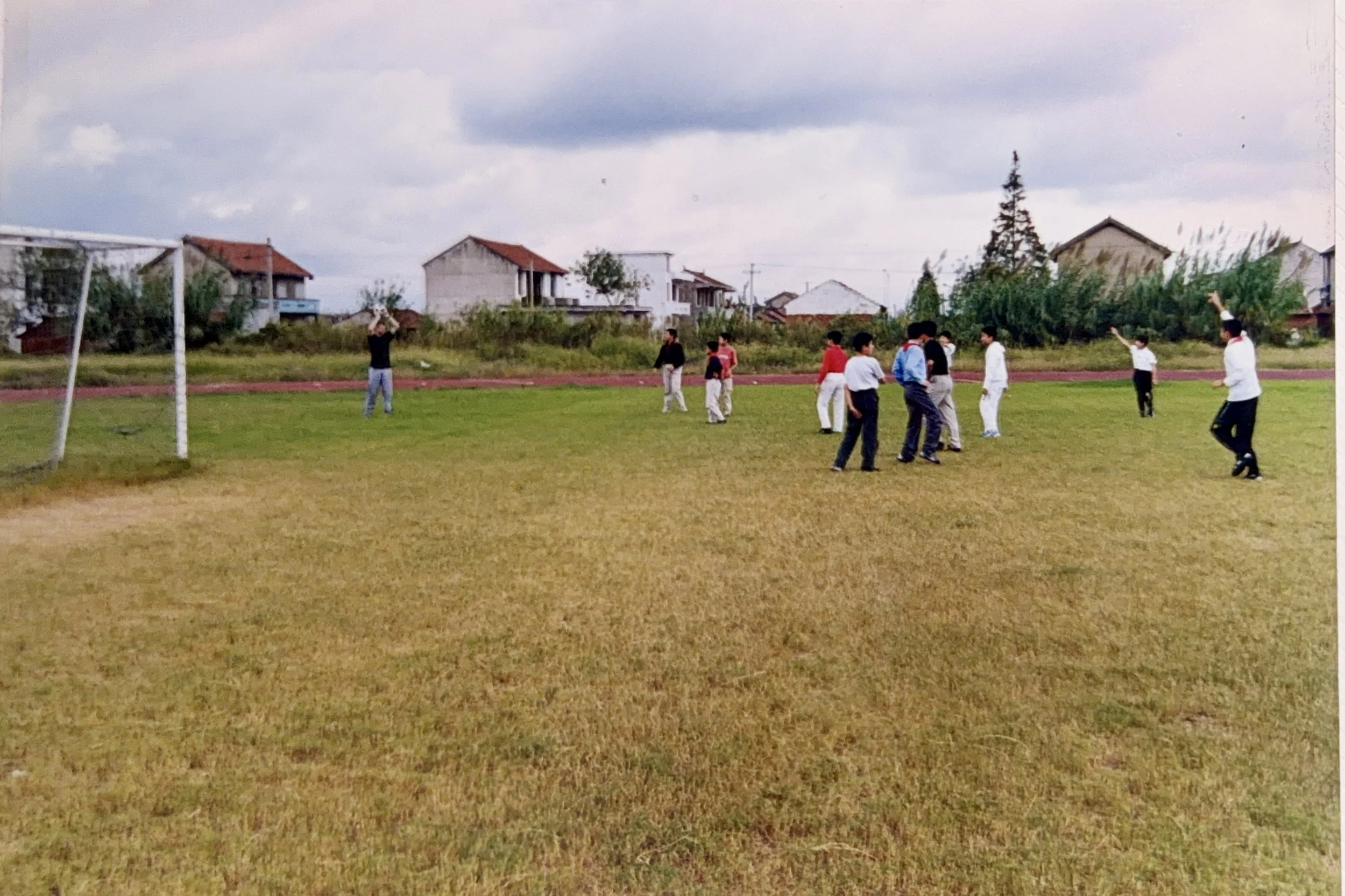
My timetable was light, so I had plenty of time to fill. Most afternoons, you'd find me on the football pitch, running ragged with a pack of screaming boys who treated every match like the World Cup final. When I wasn't sweating on the pitch, I was hanging out in the PE office, a gloriously chaotic space filled with sweat, sports equipment, old score sheets, and the easy camaraderie of the physical education staff.
It was there that I met Lily.
She worked in the PE office. I can't remember exactly what was said that first time probably something mundane about lesson plans or equipment but I remember seeing her red tracksuit bottoms and blue top. A shift. A spark. The beginning of something I couldn't have predicted when I'd boarded that plane at Gatwick.
The Accidental Celebrity

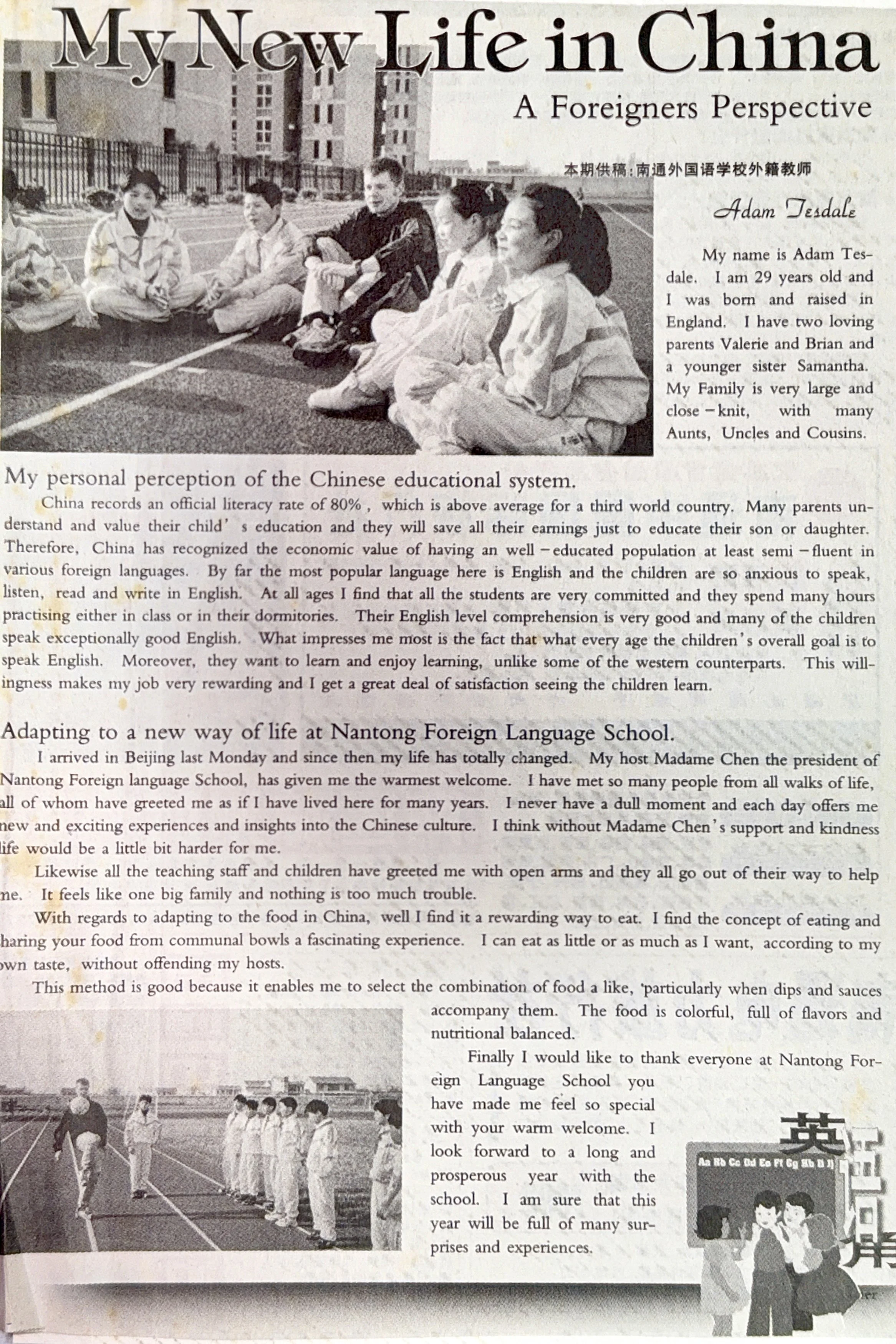
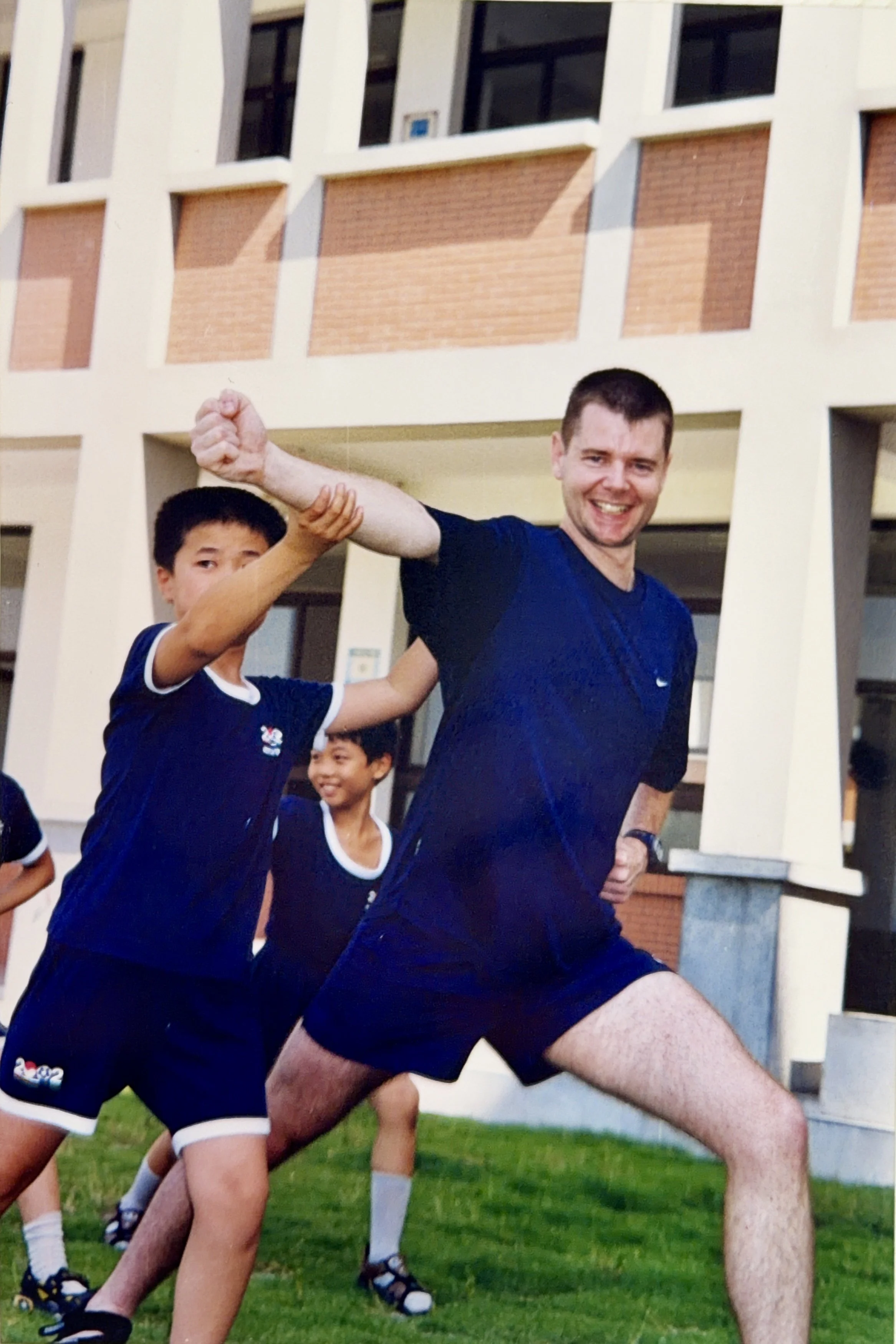
As if landing in a foreign country and meeting my future wife wasn't surreal enough, I soon discovered that being the first foreigner at the school came with unexpected perks. And by perks, I mean fame. Utterly bizarre, completely undeserved fame.
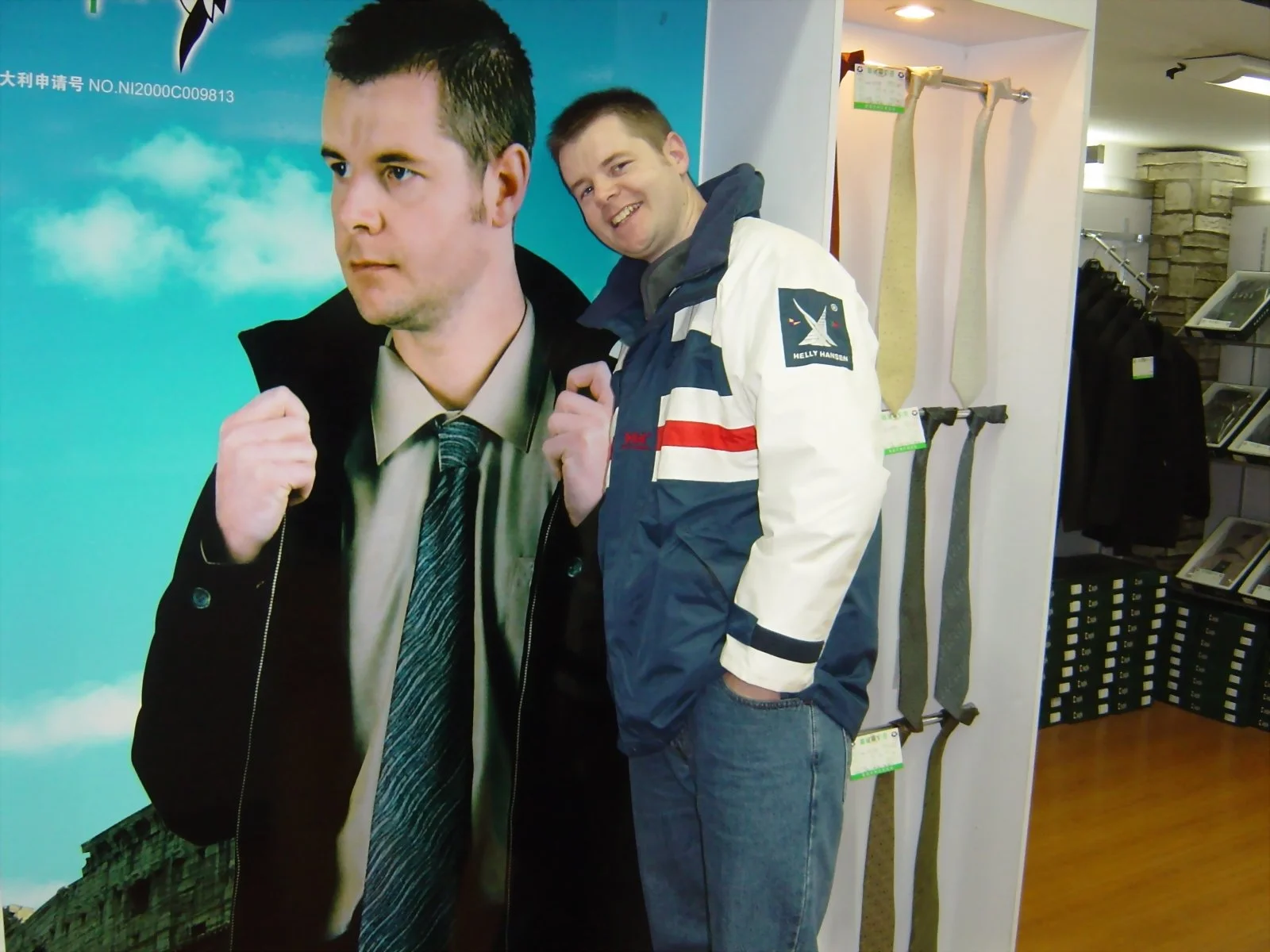
The principal's husband, as I mentioned ran the local TV station. One day, he arrived with a camera crew and interviewed me for a news segment. I answered questions about England, about teaching, about my impressions of China, trying my best not to look like a deer caught in headlights. It aired that evening, and suddenly, I was recognisable.
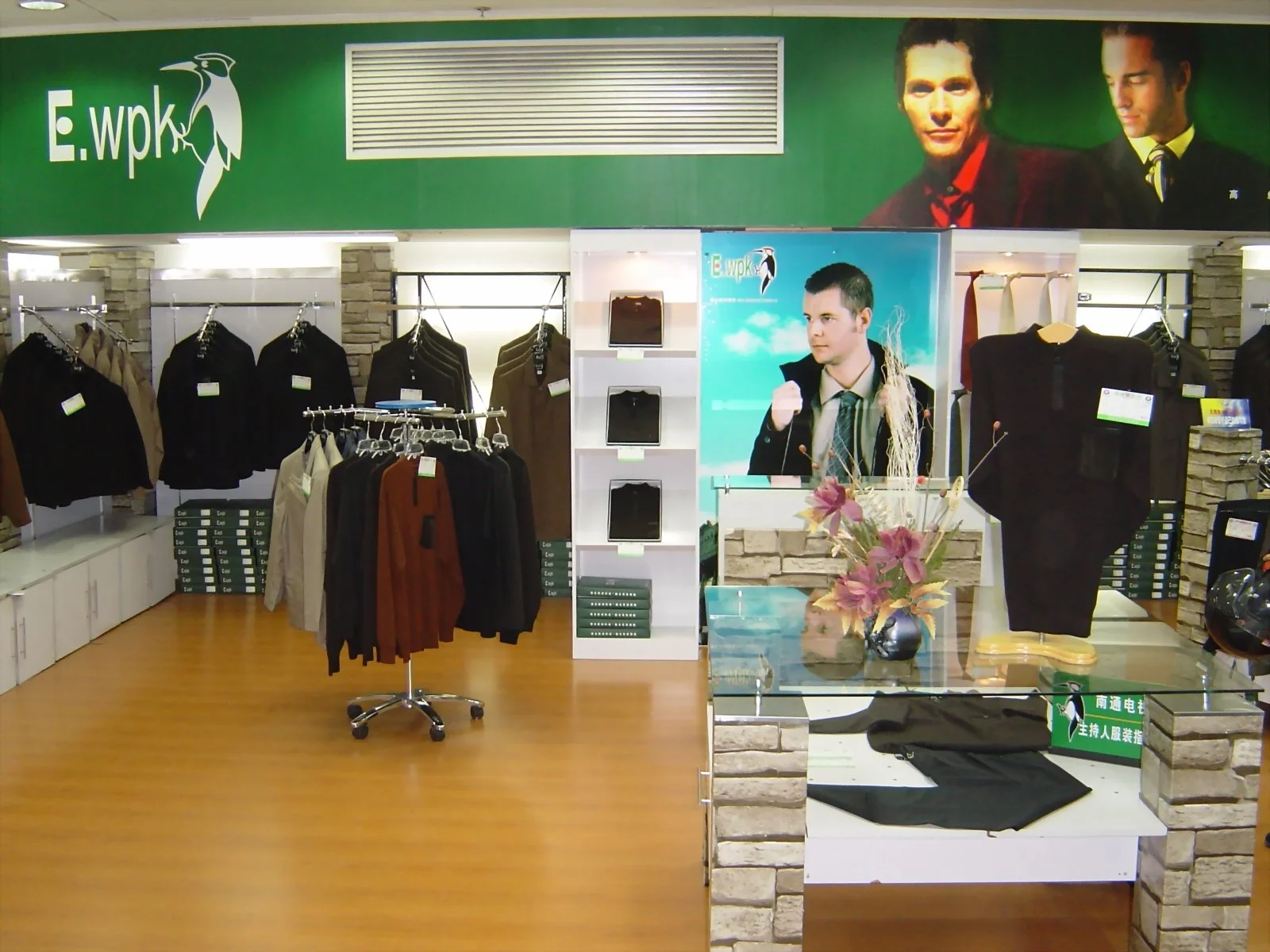
It didn't stop there. I appeared on television with alarming regularity. My face popped up in the local newspaper. And then came the billboards. Yes, billboards. Apparently, having a foreign face was exotic enough to sell things, so I found myself plastered across the city as a model for who-knows-what. I'd be walking down the street and see myself staring back from a poster. Students would point. Shopkeepers would whisper. It was all so utterly surreal.
The Birthday That Nearly Killed Me
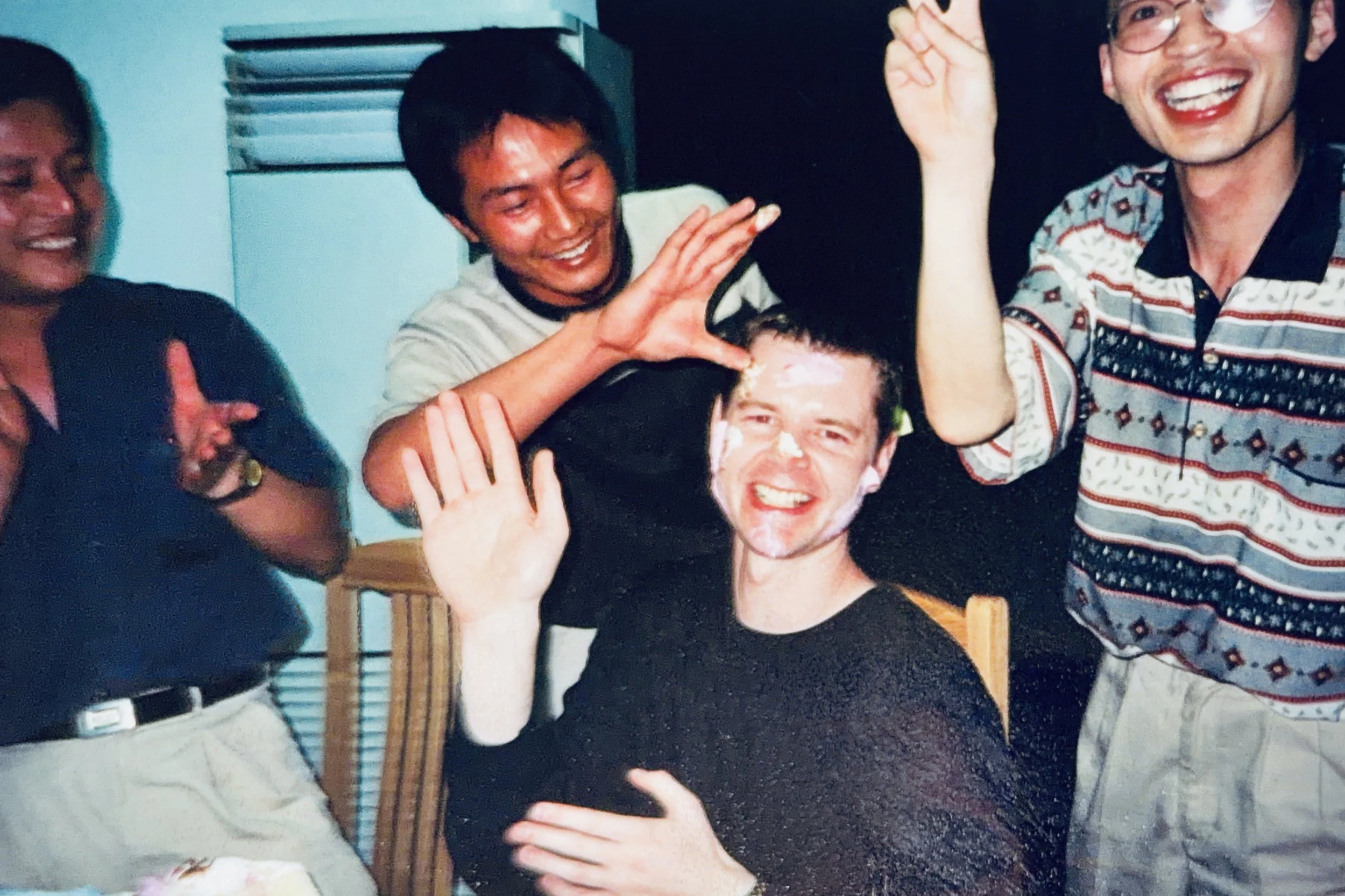
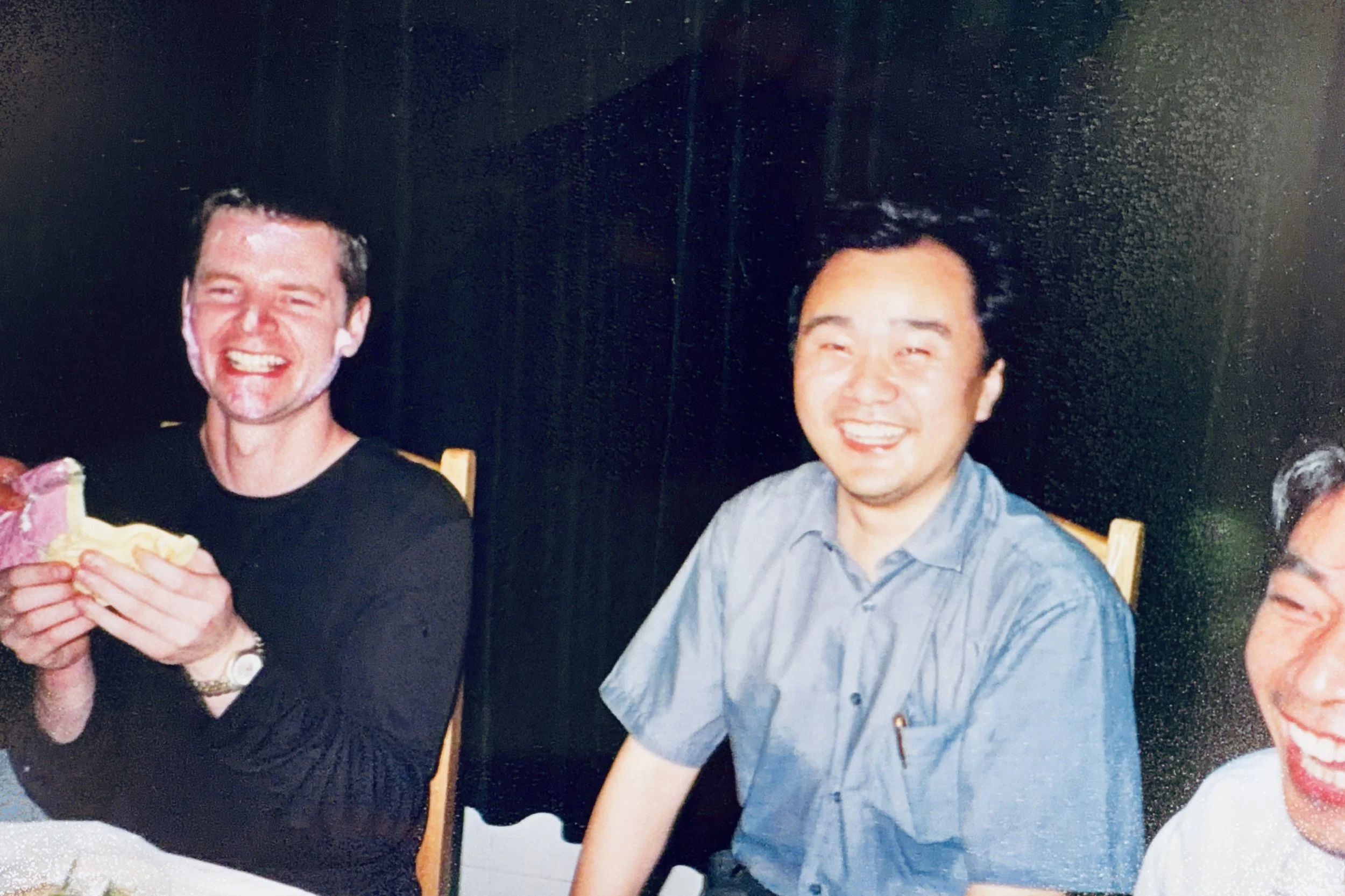
Of all the surreal moments, none quite compared to my 30th birthday.
The staff, bless them, had organised a party. There was a cake with candles, enthusiastic singing, and the kind of genuine warmth that made me forget, for a moment, that I was 5,000 miles from home. Then came the toasts.
Huge glasses were placed before me. Not tiny Moutai shots this time. These were filled to the brim with the cheapest baijiu imaginable—the stuff they called "bijou" and served by the litre. My new friends cheered. They clapped me on the back. They refilled my glass almost before I'd drained it.
I woke up two days later on the back of a black out with some concerned faces looking at me.
I'm not being dramatic. I genuinely did not teach for two days. I lay in my room, curtains drawn, convinced I was dying. The world spun. My head pounded. My stomach staged a mutiny. I found it character-building. Barely.
The Physical Toll of a New World
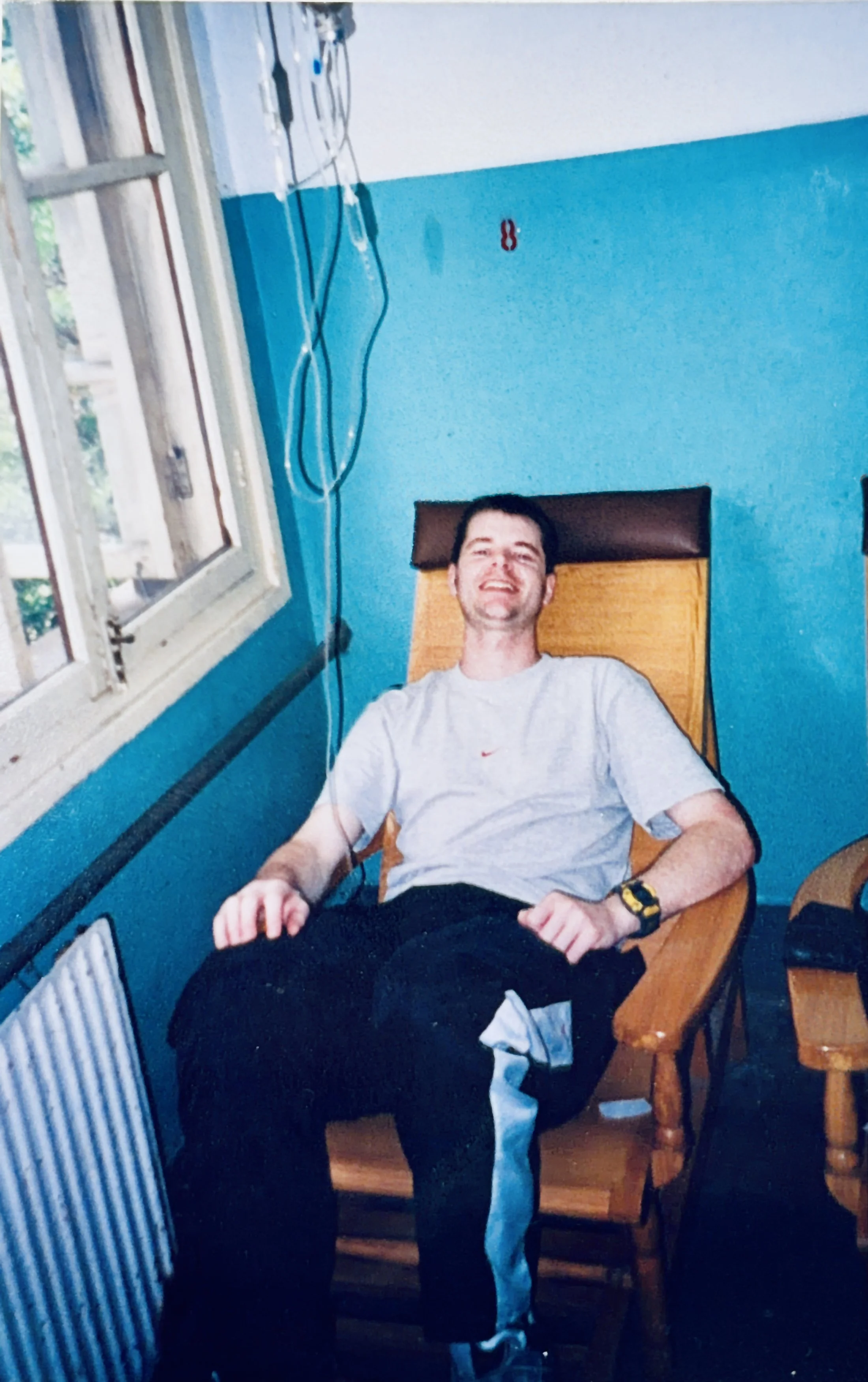
That birthday disaster was just the most dramatic example of a ongoing battle. The changes in drink and diet played havoc with my body. Rich foods, unfamiliar oils, and the constant presence of shellfish (which I couldn't eat anyway) kept my digestive system in a state of permanent confusion. My gallbladder, in particular, staged regular protests. I lost count of the times I ended up in a clinic, weak and feverish, only to have a nurse slide an IV needle into my arm and pump me full of fluids. It became almost routine. Feel terrible. Visit clinic. Get IV. Feel better. Repeat.
It should have been miserable. And yet, somehow, it wasn't. The kindness of the staff, the friendship of my colleagues, the growing connection with Lily it all outweighed the physical toll. I was living a life I could never have imagined back in Chipping Sodbury. And despite the baijiu hangovers and the gallbladder attacks, I wouldn't have traded it for anything.
Tea Houses, Coffee Dreams, Dumplings, and the Foxtrot: Immersing Myself in a New World.
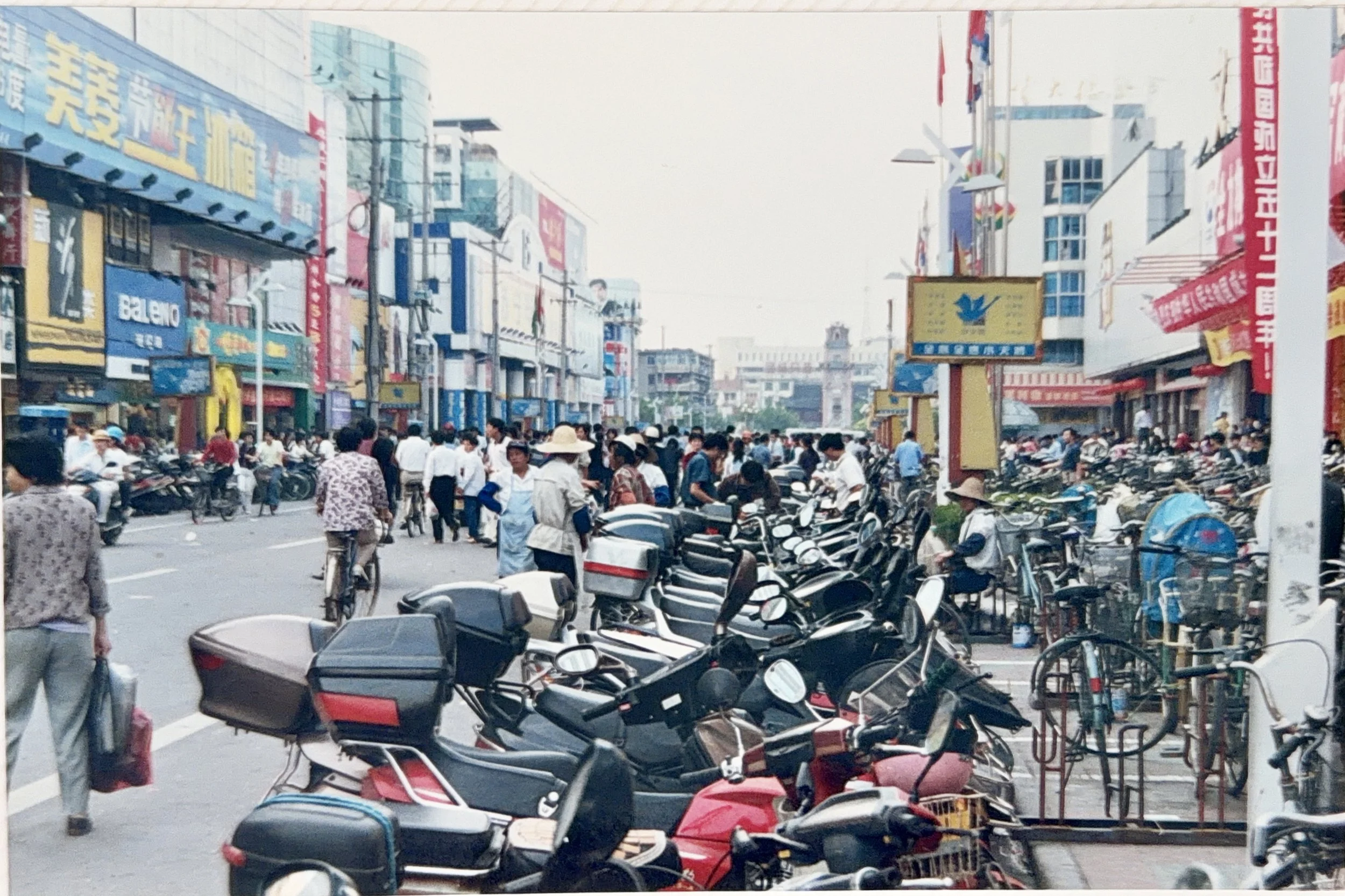
My days settled into a comfortable rhythm, a gentle oscillation between the classroom and everything else. With only twenty hours of teaching a week, I had time. Time to explore. Time to observe. Time to simply be in this strange, beautiful, chaotic country. And I took every opportunity to immerse myself in a culture that was vastly different from anything I'd known in the Cotswolds.
The PE team, my unofficial guardians and partners in crime, took me under their wing. They filled my days with colour. They didn't just tolerate the clueless foreigner; they adopted him. They showed me the Nantong that existed beyond the school gates, the real Nantong of backstreets, hidden gems, and daily rituals.
One of our favourite escapes was the local tea house. We'd sneak off campus over under the fence, through the gap, whatever it took and settle into a quiet corner with cups of fragrant jasmine or earthy oolong. It was a world away from the staffroom. The pace was slower. The conversation flowed easier. And the tea was endless. It became our sanctuary, a place where I wasn't the foreign teacher, just Adam, a friend who was slowly learning to navigate this new place.
Finding a decent coffee, however, was a different matter entirely. In those days, Nantong had exactly one coffee house. It was called Ming Dian. I can still picture it: a small, ambitious spot that tried to bring a little Western café culture to the banks of the Yangtze. It's long gone now, another victim of the city's relentless development, but back then, it was a lifeline. Occasionally, when we were feeling fancy, we'd abandon the tea house and head to Ming Dian for an overpriced, slightly burnt espresso. It wasn't London. It wasn't even Worcester. But it was coffee, and it tasted like home.
And then there was lunch.
Almost every day, we'd wander off Nandajie Street to a tiny dumpling restaurant that became our second canteen. It was nothing special to look at—plastic tables, mismatched chairs, steam fogging the windows—but inside, magic happened. For 20 RMB, we ate like kings. Plate after plate of delicate dumplings, their thin skins hiding glorious pockets of pork and chive, or cabbage and mushroom. And then came the duck blood soup. I know how that sounds. I know. But trust me when I say it was pure bliss—a rich, savoury broth with silky cubes of congealed blood that melted on the tongue. It was warming, nourishing, and utterly delicious. We'd leave stuffed, happy, and poor only in the most technical sense. Back home, 20 RMB wouldn't buy you a sandwich. Here, it bought a feast and a family.
The Foxtrot Fiasco
And then there were the evenings that defied all expectation.
Somehow, somewhere, someone in the PE team had discovered ballroom dancing. And not just discovered they'd embraced it. Occasionally, we'd all pile into an old, slightly decrepit basketball hall that had been repurposed for the evening. The hoops were still there, looming overhead like silent spectators, as a small group of us gathered on the polished wooden floor.
Picture it. Me. Adam from Chipping Sodbury. Trying to foxtrot.
I cannot stress enough how hilarious this was. I had the coordination of a newborn giraffe and the natural rhythm of a washing machine on spin cycle. My new friends would try to guide me through the steps, their laughter echoing off the walls as I stumbled, stepped on toes, and generally made a spectacle of myself. The waltz was no better. I was supposed to glide; I lurched. I was supposed to spin; I staggered. I stood on Lily’s feet.
It was ridiculous. It was embarrassing. And it was one of the best things I've ever done.
Because in that dusty basketball hall, stumbling through a foxtrot with a bunch of Chinese PE teachers, I wasn't a foreigner. I wasn't the celebrity from the billboards. I was just a bloke, making a fool of himself, laughing until my sides hurt, and feeling more at home than I had any right to.
Between the dumplings, the tea houses, the terrible dancing, and the friendship that surrounded me, I was living a life I could never have imagined back in the Cotswolds. And I was only just getting started.